
Surfaces and Symmetry: Prisms, Trigonometric Functions, and Secant Lines
Loading the math board and drawing, please wait…
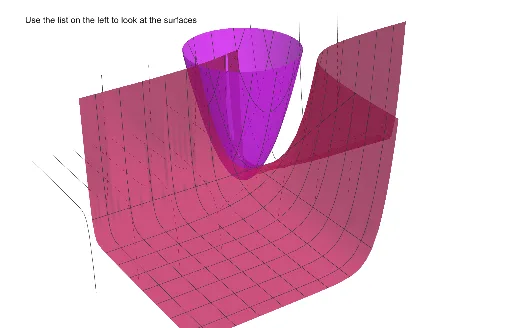
① This GeoGebra example constructs a comprehensive dynamic geometry scene combining surfaces, prisms, trigonometric function graphs, and secant line reflections, visually demonstrating the symmetry between 3D surfaces and 2D function plots. ② Core mathematical concepts include solid geometry (prisms and surfaces), trigonometric functions (e.g., sine/cosine periodicity), the geometric meaning of secant lines, and reflection transformations that affect symmetry. ③ Construction highlights: from the summary, objects a, b, c (likely parameters or geometric elements) and text1 (a text label) are used; GeoGebra commands generate surfaces, prisms, trigonometric curves, and secant lines, with reflection tools applied to achieve symmetric effects, emphasizing parameter-driven dynamic interaction. ④ Suitable for high school to early college students, this example helps understand the relationship between 3D surfaces and 2D function graphs, the geometric essence of symmetry transformations, and applications of trigonometric functions in solid geometry; it also serves as a teaching demo or student exploration material.
GeoGebra Commands & Parameters
a(x, y) = x^(2) + y^(2)b(x, y) = x + (2 * y)c(x, y) = x^(y)
AI Drawing Prompt Reference
Draw a 3D surface consisting of a conical surface x^2 + y^2, a slanted plane x + 2y, and an exponential surface x^y. Show the symmetry between these surfaces by adding their secant lines.
The prompt above was compiled from the original drawing commands and is for reference only.