
Surface Area (# of faces) – Polyhedron Approximation and Limit
Loading the math board and drawing, please wait…
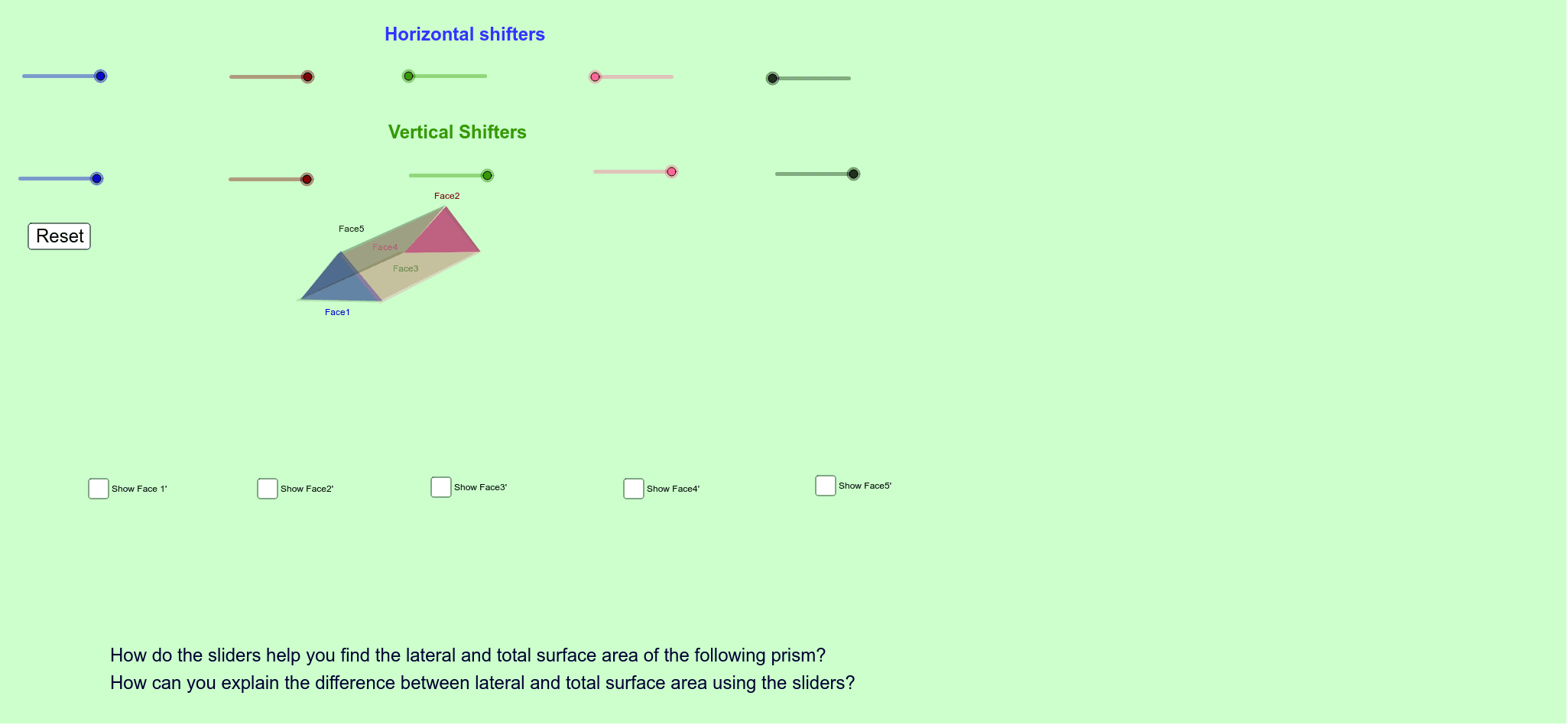
This GeoGebra example dynamically illustrates how the surface area of a polyhedron composed of triangular faces changes as the number of faces increases, demonstrating the convergence of the total area to a limiting value (e.g., a curved surface like a sphere). Core mathematical concepts include polyhedron surface area, limits, similar triangles, and logarithmic functions in the approximation process. Construction highlights: using Polygon to create base polygons, Intersect for intersection points, Vector and Translate to replicate faces, and Vertex to extract coordinates, resulting in multiple faces (Face_1, Face, etc.) that simulate subdivision. Suitable for high school to college students to grasp the limit idea in calculus, and useful for exploring the interplay between solid geometry and coordinate geometry.
GeoGebra Commands & Parameters
Polygon(A, B, C) → poly1, c, a, bPolygon(D, E, F) → poly2, f, d, ePolygon(G, H, I, J) → Face_1, g, h, i_1, j_1Polygon(K, L, M, N) → Face, k_1, l_1, m_1, n_1Polygon(O, P, Q, R) → Face_2, o, p_1, q_1, rIntersect(g, o) → SVector(T, U) → uTranslate(D, u) → D'Translate(E, u) → E'Translate(F, u) → F'Polygon(D', E', F') → Face1, f', d', e'Vertex(Face, 1) → VVector(W, Z) → vTranslate(A, v) → A'Translate(B, v) → B'Translate(C, v) → C'Polygon(A', B', C') → Face2, c', a', b'Vector(A_1, B_1) → wTranslate(O, w) → O'Translate(P, w) → P'Translate(Q, w) → Q'Translate(R, w) → R'Polygon(O', P', Q', R') → Face3, o', p', q', r'Vector(C_1, D_1) → lTranslate(K, l) → K'Translate(L, l) → L'Translate(M, l) → M'Translate(N, l) → N'Polygon(K', L', M', N') → Face4, k', l', m', n'Vector(E_1, F_1) → sTranslate(G, s) → G'Translate(H, s) → H'Translate(I, s) → I'Translate(J, s) → J'Polygon(G', H', I', J') → Face5, g', h', i', j'Polygon(G_1, H_1, I_1) → Face1', i_2, g_1, h_1Polygon(J_1, K_1, L_1) → Face2', l_2, j_2, k_2Polygon(M_1, N_1, O_1, P_1) → Face3', m_2, n_2, o_1, p_2Polygon(Q_1, R_1, S_1, T_1) → Face4', q_2, r_1, s_1, t_1Polygon(U_1, V_1, W_1, Z_1) → Face5', u_1, v_1, w_1, z_1