
Supplementary Angles
Loading the math board and drawing, please wait…
In collections
geometriadinamica.es
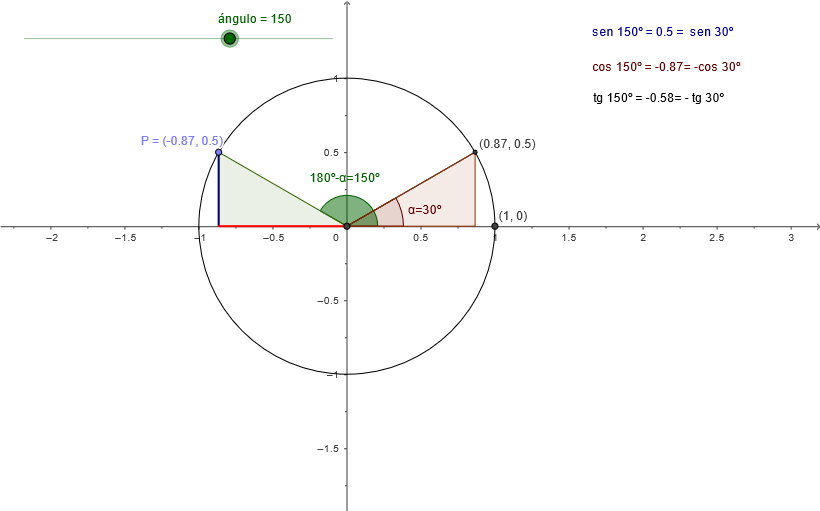
This example illustrates the concept of supplementary angles, where the sum of two angles is 180 degrees. Using GeoGebra commands such as Circle, Intersect, Rotate, Segment, Polygon, and Angle, the properties of supplementary angles are demonstrated. Suitable for middle and high school students learning geometry and trigonometry.
GeoGebra Commands & Parameters
Circle((0, 0), 1) → cIntersect(c, xAxis, 2) → AIntersect(xAxis, yAxis) → ORotate(A, (ángulo * pi / 180), O) → PSegment(P, O) → bSegment(P, (x(P), 0)) → senSegment((x(P), 0), O) → cosPolygon(P, O, (x(P), 0)) → Q, a, d, eAngle(P, O, A) → βMirror(P, yAxis) → P'Segment(P', O) → fAngle(A, O, P') → αMirror(P, xAxis) → P'_1Mirror((x(P), 0), xAxis) → BPolygon(P', O, ((-x(B)), 0)) → Q', g, h, i
AI Drawing Prompt Reference
Draw a coordinate plane, then construct a circle centered at the origin O with radius 1. Let A be the intersection of the circle with the x-axis. Rotate point A about O by a given angle to obtain P, and draw the segment OP. From P, draw the segment(s) meeting the x-axis to indicate the sine and cosine directions, and form a polygon using P, O, and that x-axis point. Mark the angle β at O formed by the rays OP and OA. Reflect P across the y-axis to get P′, draw the segment P′O and mark the corresponding angle α. Reflect the appropriate x-axis point across the x-axis to obtain the mirrored geometry on the lower side, and draw the corresponding polygon so the supplementary-angle arrangement (sum 180°) is visually demonstrated.
The prompt above was compiled from the original drawing commands and is for reference only.