
Sum of Natural Numbers and Geometric Figures
Loading the math board and drawing, please wait…
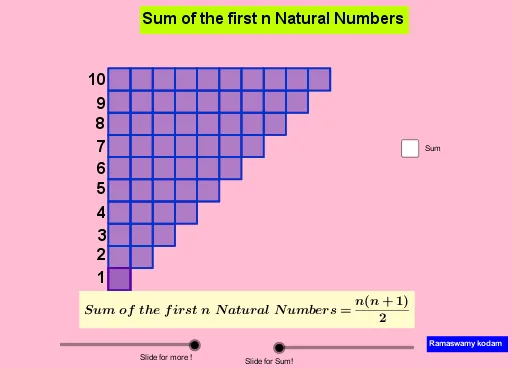
This example demonstrates the sum of natural numbers and its geometric representation. Key mathematical concepts include arithmetic series summation, geometric area calculations, and coordinate geometry applications. Construction involves GeoGebra commands like Point, Intersect, and Polygon. Suitable for middle school students learning the integration of geometry and algebra, suitable for classroom teaching or self-study.
GeoGebra Commands & Parameters
Point(xAxis) → AIntersect(xAxis, yAxis) → BSegment(B, A) → fPolygon(B, A, 4) → poly1, g, h, i, j, C, DSegment(A, B) → kSegment(A, C) → lSegment(C, D) → mSegment(D, B) → n_1Sequence(Sequence[Translate[poly1, (i, j)], i, 0, j], j, 0, Min[(floor(t + 1) * (n - 1)), n - 1]) → l1Mirror(l1, E) → l1'Rotate(l1, ((-Min[t, 1]) * 180°), E) → l1'_1
AI Drawing Prompt Reference
Draw a coordinate system with the origin O, and point A on the x-axis. Connect OA and OB, where OB intersects the y-axis at B. Draw a square with B and A as vertices. Then, starting from A, draw 4 more squares to the right, each with a side length 1 unit longer than the previous one. Next, translate the first square along the x-axis, each time by the length of the previous square, until the number of translations equals the number of squares minus one. Finally, mirror all squares to the right side of the y-axis and rotate them 180 degrees counterclockwise.
The prompt above was compiled from the original drawing commands and is for reference only.