
Sum of Infinite Geometric Series via Similar Triangles
Loading the math board and drawing, please wait…
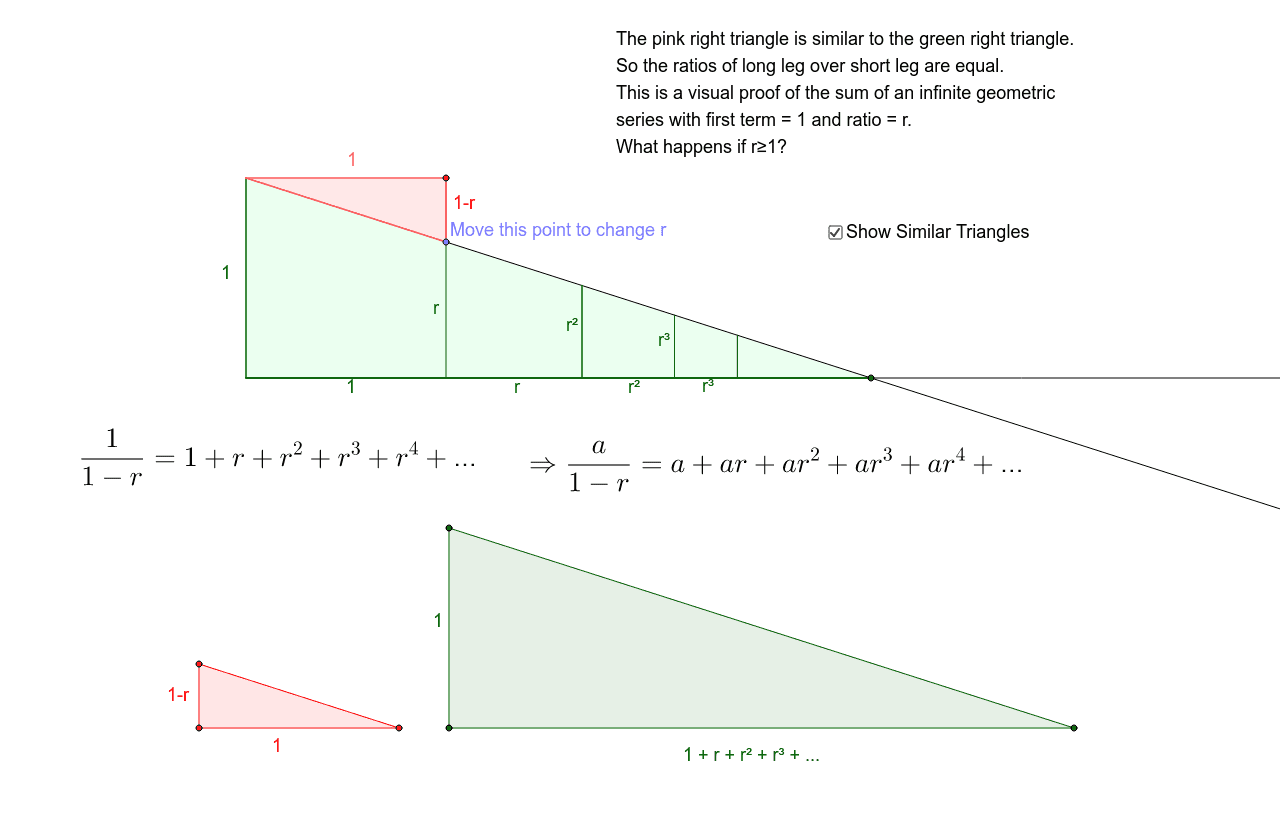
① This example demonstrates the geometric summation of an infinite geometric series by nesting a sequence of similar triangles, where the total area converges to a finite limit as the triangles shrink. ② Core mathematical concepts include similar triangles, geometric sequences, infinite series summation, limits, and convergence of geometric series. ③ Construction highlights: Using GeoGebra commands such as Point, OrthogonalLine, Intersect, Circle, Ray, Polygon, Segment, Rotate, Line, and Distance, the construction creates a chain of similar triangles with a controllable scaling factor (via sliders or parameters), visually showing the partial sums approaching the total. ④ Suitable for high school and college students learning sequences and series, or for calculus instructors demonstrating geometric series convergence interactively; also useful for creating dynamic math lessons.
GeoGebra Commands & Parameters
Point(b) → AOrthogonalLine(A, b) → cIntersect(a, c) → BCircle(A, B) → dIntersect(d, b, 2) → COrthogonalLine(C, b) → eIntersect(a, e) → DPoint(e) → ERay(A, E) → fIntersect(a, f) → FPolygon(A, B, D, C) → poly1, a_1, b_1, d_1, c_1Ray(B, D) → gPolygon(A, F, B) → poly2, b_2, a_2, f_1Segment(D, E) → rRotate(E, 270*°, D) → E'OrthogonalLine(E', a_2) → hIntersect(h, f) → GSegment(G, E') → iSegment(D, E') → jRotate(G, 270*°, E') → G'Segment(E', G') → kOrthogonalLine(G', a_2) → lIntersect(l, f) → HSegment(H, G') → mRotate(l, 270*°, G') → l'Rotate(H, 270*°, G') → H'Rotate(G', 270*°, G') → G''Segment(H', G'') → m'Line(H', d_1) → nIntersect(n, f) → ISegment(I, H') → pSegment(C, E) → qPolygon(A, C, E) → poly3, e_1, a_3, c_2Distance(C, E) → CEDistance(A, C) → ACPolygon(J, K, L) → poly4, l_1, j_1, k_1Distance(A, B) → ABIntersect(f, g) → ODistance(B, O) → BOPolygon(N, M, P) → poly5, p_1, n_1, m_1
AI Drawing Prompt Reference
Draw a diagram illustrating the sum of an infinite geometric series via nested similar triangles. Start with a base line and a point outside it; draw a perpendicular from the point to the line, forming an initial triangle. Use a circle with diameter equal to one side of the triangle to intersect the line, then draw another perpendicular to create a smaller similar triangle. Repeat this process to generate a chain of shrinking similar triangles. Include a slider to control the scaling factor, showing the areas decreasing geometrically and the total area converging to a finite limit. Mark side lengths, areas, and partial sums, and connect key points with segments to visualize the convergence of partial sums to the limit.
The prompt above was compiled from the original drawing commands and is for reference only.