
Sum of Distances from a Point to Sides of an Equilateral Triangle
Loading the math board and drawing, please wait…
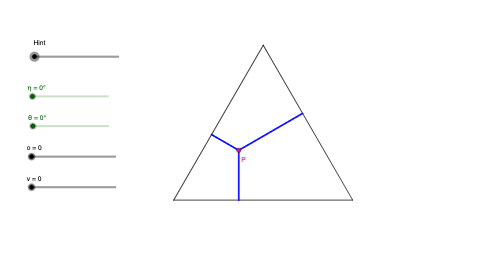
This example demonstrates that the sum of the shortest distances from any point inside an equilateral triangle to its three sides equals the height of the triangle. Key math concepts include equilateral triangle properties, distance measurement, and geometric construction. It uses commands like Polygon, PointIn, OrthogonalLine, Intersect, Segment, Rotate, etc. Suitable for high school mathematics education to explore geometric properties and proofs.
GeoGebra Commands & Parameters
Polygon(A, B, 3) → poly1, f, g, h, CPointIn(poly1) → POrthogonalLine(P, g) → iOrthogonalLine(P, f) → jOrthogonalLine(P, h) → kIntersect(j, f) → EIntersect(k, h) → FIntersect(i, g) → GSegment(C, A) → lSegment(A, B) → mSegment(B, C) → nSegment(F, P) → pSegment(P, G) → qSegment(P, E) → rRotate(G, 30°, P) → G'Angle(G, P, G') → αRotate(G, -30°, P) → G'_{1}Angle(G'_{1}, P, G) → βRay(P, G') → sRay(P, G'_{1}) → tIntersect(n, s) → HIntersect(n, t) → IRotate(F, 30°, P) → F'Angle(F, P, F') → γRotate(F, -30°, P) → F'_{1}Angle(F'_{1}, P, F) → δRay(P, F'_{1}) → aRay(P, F') → bIntersect(l, a) → JIntersect(l, b) → KRotate(E, 30°, P) → E'Angle(E, P, E') → εRotate(E, -30°, P) → E'_{1}Angle(E'_{1}, P, E) → ζRay(P, E'_{1}) → cRay(P, E') → dIntersect(m, c) → LIntersect(m, d) → MPolygon(J, P, K) → t1, k_1, j_1, d_1Polygon(P, L, M) → t2, m_1, d_2, l_1Polygon(P, H, I) → t3, i_1, d_3, h_1Centroid(t3) → NRotate(P, (-η), N) → D'Rotate(H, (-η), N) → H'Rotate(I, (-η), N) → I'Polygon(D', H', I') → t3', i', d', h'Rotate(P, (-η), N) → D'_{1}Rotate(G, (-η), N) → G'_{2}Segment(D'_{1}, G'_{2}) → q'Line(C, P) → eCentroid(t1) → ORotate(J, (-θ), O) → J'Rotate(P, (-θ), O) → D'_{2}Rotate(K, (-θ), O) → K'Polygon(J', D'_{2}, K') → t1', k', j', d'_{2}Rotate(F, (-θ), O) → F'_{2}Rotate(P, (-θ), O) → D'_{3}Segment(F'_{2}, D'_{3}) → p'Circle(J, o) → c_1Distance(J, C) → dJCIntersect(c_1, l, 1) → P_{1}Vector(J, P_{1}) → uTranslate(J', u) → J''Translate(D'_{2}, u) → QTranslate(K', u) → K''Polygon(J'', Q, K'') → t1'', k'', j'', q_1Translate(F'_{2}, u) → RTranslate(D'_{3}, u) → SSegment(R, S) → p''Segment(V, W) → g_1Midpoint(V, W) → A_1OrthogonalLine(A_1, g_1) → f_1OrthogonalLine(C, f_1) → n_1Intersect(f_1, n_1) → TOrthogonalLine(A_1, g_1) → p_1OrthogonalLine(V, g_1) → r_1OrthogonalLine(W, g_1) → s_1Intersect(r_1, n_1) → UIntersect(n_1, s_1) → ZOrthogonalLine(H, p_1) → t_1Intersect(f_1, p_1) → C_1Intersect(f_1, p_1) → D_1Intersect(t_1, f_1) → E_1Distance(H, E_1) → dHE1OrthogonalLine(P, p_1) → a_1Intersect(f_1, p_1) → I_1Intersect(f_1, p_1) → J_1Intersect(f_1, p_1) → K_1Intersect(f_1, p_1) → L_1Intersect(a_1, f_1) → M_1Distance(P, M_1) → dDM1Circle(P, (v * dDM1 / 6)) → e_2Intersect(e_2, a_1, 1) → N_1Vector(P, N_1) → v_1Translate(P, v_1) → D'_{4}Translate(E, v_1) → E'_{2}Segment(D'_{4}, E'_{2}) → r'Segment(U, Z) → b_1Segment(T, A_1) → f_2Segment(C, T) → g_2Segment(B, A_1) → h_2Segment(H, E_1) → i_2Segment(P, M_1) → j_2Circle(C, v) → c_2Intersect(c_2, n_1, 1) → B_1Vector(C, B_1) → wTranslate(R, w) → R'Translate(S, w) → S'Segment(R', S') → p'''Circle(H, (v * dHE1 / 6)) → k_2Intersect(k_2, t_1, 1) → F_1Vector(H, F_1) → u_1Translate(D'_{1}, u_1) → G_1Translate(G'_{2}, u_1) → H_1Segment(G_1, H_1) → q''Point(g) → O_1Circle(B, A) → p_2Circle(A, B) → q_2Intersect(p_2, q_2) → D, Q_1, ,
AI Drawing Prompt Reference
Draw an equilateral triangle ABC, then select a point P inside the triangle. Construct perpendiculars from P to each side of the triangle, marking the feet of the perpendiculars as E, F, and G. Rotate E, F, and G around P to form new points E', F', and G'. Connect P to E', F', and G', and connect E', F', and G' to the vertices of the triangle to form new triangles. Find the centroids of these triangles and rotate P, E, F, and G around the centroid to form new points D', H', and I'. Connect these points to form the final triangle.
The prompt above was compiled from the original drawing commands and is for reference only.