
Sum of Angles in a Triangle by Andy Talmadge
Loading the math board and drawing, please wait…
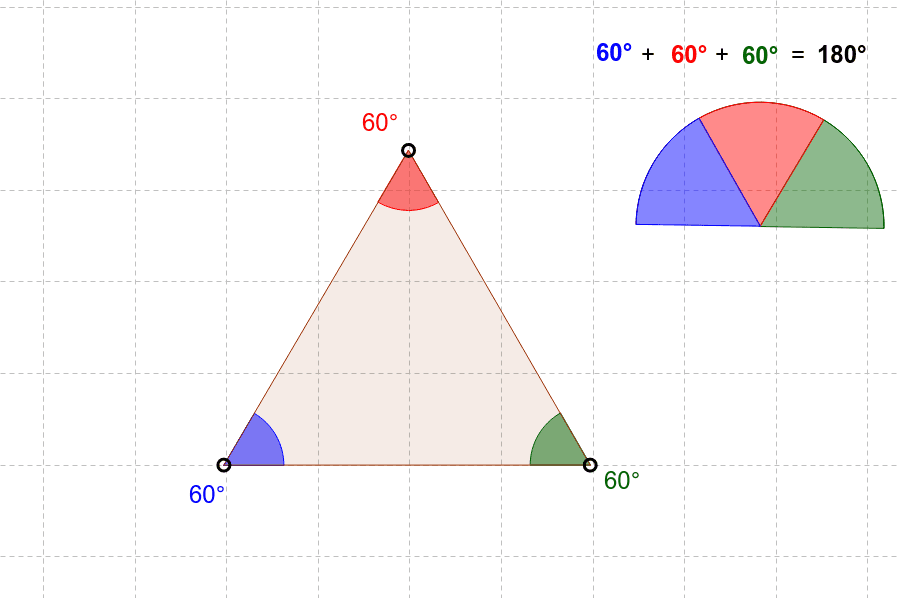
This example demonstrates how to construct a triangle and measure its interior angles using GeoGebra, illustrating the triangle angle sum theorem. Core concepts include angle measurement, geometric construction, and properties of triangles. It uses commands like Polygon, Line, Point, Circle, Intersect, Semicircle, Angle, Rotate, CircleSector. Suitable for middle school students and geometry education.
GeoGebra Commands & Parameters
Polygon(A, B, C) → poly1, c, a, bLine(D, E) → dPoint(d) → FPoint(d) → GCircle(F, G) → eIntersect(e, d, 2) → HSemicircle(H, G) → fAngle(A, C, B) → α_4Rotate(G, α_4, F) → G'Angle(G, F, G') → βCircleSector(F, G, G') → gAngle(B, A, C) → γRotate(G', γ, F) → G''CircleSector(F, G', G'') → hAngle(C, B, A) → δCircleSector(F, G'', H) → kPolygon(A_1, B_1, C_1) → poly1_1, c_1, a_1, b_1Angle(A_1, C_1, B_1) → α_1Angle(B_1, A_1, C_1) → γ_1Angle(C_1, B_1, A_1) → δ_1Polygon(A_2, B_2, C_2) → poly1_2, c_2, a_2, b_2Angle(A_2, C_2, B_2) → α_2Angle(B_2, A_2, C_2) → γ_2Angle(C_2, B_2, A_2) → δ_2Polygon(A_3, B_3, C_3) → poly1_3, c_3, a_3, b_3Angle(A_3, C_3, B_3) → α_3Angle(B_3, A_3, C_3) → γ_3Angle(C_3, B_3, A_3) → δ_3
AI Drawing Prompt Reference
Draw a triangle to demonstrate the triangle angle sum theorem. Construct triangle ABC using line segment DE as a reference. Take points F and G on DE, draw circles centered at F and G, and intersect them with DE to get point H. Then draw a semicircle from H to G. Measure angles A, B, and C of triangle ABC. Use rotations and circular arcs to show how to verify that the sum of the interior angles is 180 degrees. Key objects include triangle ABC, points F, G, H, the semicircle, and the three angles. Additionally, construct another triangle A1B1C1 and another triangle A2B2C2, measure their angles, to demonstrate the theorem's generality.
The prompt above was compiled from the original drawing commands and is for reference only.