
Subtracting Integers on the Real Number Line
Loading the math board and drawing, please wait…
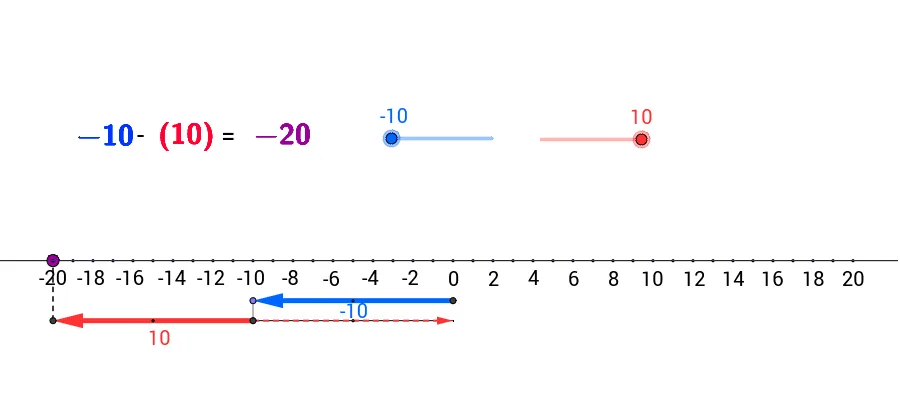
This example demonstrates the concept of subtracting integers on the real number line. It involves the core mathematical concepts of integers and the real number line. Using GeoGebra commands such as Line, Point, Circle, Vector, etc., the subtraction process is visually illustrated. Suitable for middle school mathematics education to help students understand integer subtraction.
GeoGebra Commands & Parameters
Line(A, B) → aPoint(a) → CCircle(C, 4) → kOrthogonalLine(C, a) → dIntersect(k, d, 2) → R_1Intersect(k, d, 1) → J_1Circle(C, 2) → pIntersect(p, d) → I_1, L_5Circle(L_5, 1) → gIntersect(g, d, 1) → N_1Circle(R_1, N_1) → rIntersect(r, d, 2) → S_1OrthogonalLine(N_1, d) → iCircle(M_1, 1) → qIntersect(q, i) → O_1, P_1Vector(I_1, L_1) → vTranslate(O_1, v) → Q_1Mirror(Q_1, O_1) → Z_1Point(a) → DPoint(a) → EPoint(a) → FPoint(a) → GPoint(a) → HPoint(a) → IPoint(a) → JPoint(a) → KPoint(a) → LPoint(a) → MPoint(a) → NPoint(a) → OPoint(a) → PPoint(a) → QPoint(a) → RPoint(a) → SPoint(a) → TPoint(a) → UPoint(a) → VPoint(a) → WPoint(a) → YPoint(a) → ZPoint(a) → A_1Point(a) → B_1Point(a) → C_1Point(a) → D_1Point(a) → E_1Point(a) → F_1Point(a) → G_1Point(a) → H_1OrthogonalLine(I_1, d) → eOrthogonalLine(L_5, d) → hOrthogonalLine(J_1, d) → fVector(J_1, K_1) → uVector(L_5, M_1) → wVector(O_1, Q_1) → zOrthogonalLine(S_1, d) → jVector(S_1, T_1) → lSegment(J_1, S_1) → mSegment(M_1, O_1) → tOrthogonalLine(K_1, a) → nIntersect(n, a) → U_1OrthogonalLine(L_1, a) → sOrthogonalLine(T_1, a) → a_1Intersect(s, a) → W_1Intersect(a_1, a) → Y_1Segment(K_1, U_1) → b_1Segment(T_1, Y_1) → c_1Segment(L_1, W_1) → d_1Segment(I_1, L_1) → b_2Segment(J_1, K_1) → e_1Segment(L_5, M_1) → f_1Segment(Q_1, O_1) → g_1Segment(T_1, S_1) → h_1Midpoint(J_1, K_1) → Z_2Midpoint(I_1, L_1) → A_2Midpoint(L_5, M_1) → B_2Midpoint(Q_1, O_1) → C_2Mirror(O_1, O_1) → O_1'Segment(Z_1, O_1') → i_1Vector(O_1, Z_1) → u_1Segment(O_1, Z_1) → j_1Midpoint(O_1, Z_1) → V_1Segment(Z_1, Y_1) → k_1Point(a) → D_2Point(a) → E_2Point(a) → F_2Point(a) → G_2Point(a) → H_2Point(a) → I_2Point(a) → J_2Point(a) → K_2Point(a) → L_2Point(a) → M_2