
Studying the Lateral Surface Area of a Cylinder
Loading the math board and drawing, please wait…
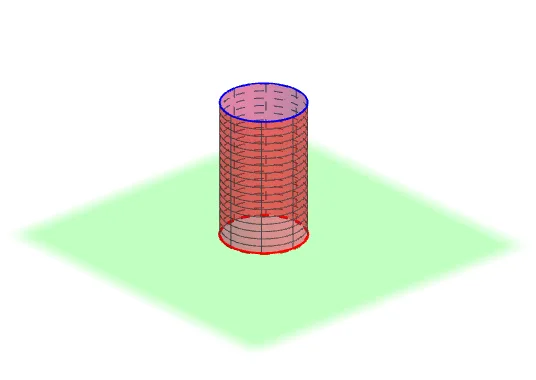
This example demonstrates the calculation and visualization of the lateral surface area of a cylinder. Key math concepts include circle, cylinder, surface area, and coordinate geometry. It uses GeoGebra commands like Circle, Cylinder, CurveCartesian, Segment, and Surface. Suitable for high school mathematics teaching and geometry learning, helping to understand the formation and calculation of the lateral surface area of a cylinder.
GeoGebra Commands & Parameters
Circle(A, r) → cCylinder(c, h) → cyl, upperBase, lateralSurfaceCurveCartesian((r * cos(t)), (r * sin(t)), t, 0, MoveMe) → luk1Segment(Q1, P1) → gCurveCartesian(ff(t), gg(t), t, 0, d / r) → Trajectory1CurveCartesian((r * cos(t)), ((-r) * sin(t)), t, 0, MoveMe) → luk2CurveCartesian(ff(t), (-gg(t)), t, 0, d / r) → Trajectory2Surface((r * cos(t)), (r * sin(t)), s, t, 0, MoveMe, s, 0, h) → cylSurf0Surface(x(Q1) + (x(q1p1) * t), y(Q1) + (y(q1p1) * t), s, t, 0, 1, s, 0, h) → cylSurf1Segment(A, A + (r, 0)) → radius