
Strings into Circles: Geometric Construction of Circle Tangents
Loading the math board and drawing, please wait…
In collections
Circle - Area & Circumference
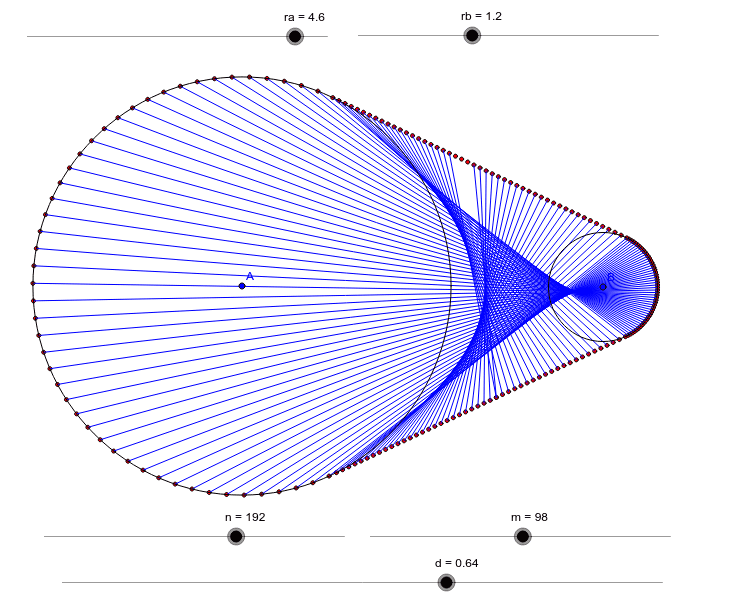
This GeoGebra example dynamically demonstrates the beautiful geometric phenomenon of strings wrapping around circles ('strings into circles') and the formation of tangent line envelopes. The core mathematical concepts involved include the properties of circles, tangent lines, intersections of geometric objects, and the use of sequences to generate discrete geometric steps. To construct this visual, the model utilizes key GeoGebra commands such as `Circle` to define the base circles (`ca`, `cb`), `Tangent` to construct tangent lines, `Intersect` to locate key points (`A`, `B`, `C`, etc.), and `Ray`, `CircleArc`, and `Segment` to draw the wrapping paths. The `Sequence` command is crucial for generating the repeating pattern of tangent segments (`t_1` to `t_4`) and arcs, simulating the physical tension of a string wrapped around cylinders. This example is highly suitable for high school and college-level geometry classes, mathematical visualization projects, or anyone interested in geometric constructions and the physics of string wrapping.
GeoGebra Commands & Parameters
Circle(A, ra) → caCircle(B, rb) → cbCircle(A, ra - rb) → eTangent(B, e) → f, gIntersect(e, g) → CRay(A, C) → hIntersect(ca, h) → D,Tangent(D, cb) → i, jIntersect(e, f) → ERay(A, E) → kIntersect(ca, k) → F,Tangent(F, cb) → l, m_1Intersect(cb, m_1) → GIntersect(cb, i) → HCircleArc(B, H, G) → t_4CircleArc(A, F, D) → t_2Segment(G, F) → t_1Segment(D, H) → t_3Sequence(Point[t, i + d - floor(i + d)], i, 0, 1, 1 / n) → PSequence(Segment[Element[P, j], Element[P, m + j]], j, 1, n, 1) → S
AI Drawing Prompt Reference
Draw two circles of different radii with their centers separated. Construct an auxiliary circle centered at the larger circle’s center with radius equal to the difference of the two radii. From the smaller circle’s center draw the two tangents to the auxiliary circle; the rays from the larger center through the tangent points intersect the larger circle at two points. From those intersection points draw tangents to the smaller circle, yielding four tangent points on it. Connect the two intersection points on the larger circle with an arc, connect the corresponding tangent points on the smaller circle with an arc, and join the matching points on the two circles with straight segments, forming a closed string‑like path wrapping both circles. Finally, place equally spaced points along this path and draw short segments between successive points to illustrate the discrete wrapping steps.
The prompt above was compiled from the original drawing commands and is for reference only.