
Stereographic Projection
Loading the math board and drawing, please wait…
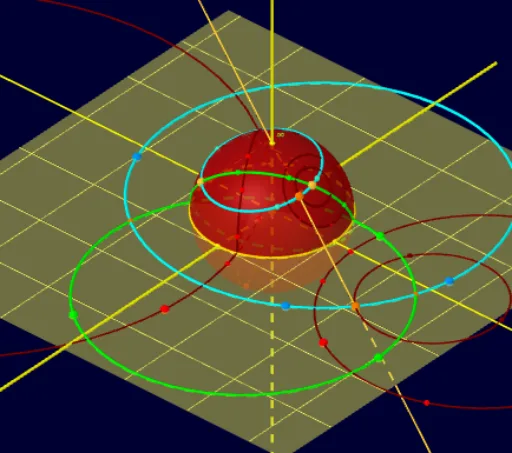
This example illustrates the concept of stereographic projection. It involves key mathematical concepts in solid geometry, such as spheres, planes, and projection lines. Using GeoGebra commands like Circle, Line, Sphere, and Intersect, users can intuitively understand the principles of stereographic projection. Suitable for high school or university solid geometry courses.
GeoGebra Commands & Parameters
Intersect(xAxis, yAxis) → ACircle(A, B) → cPoint(c) → CPoint(c) → DLine(C, D) → fPoint(c) → ELine(E, A) → gPoint(zAxis) → FSphere(A, F) → aOrthogonalLine(F, xOyPlane) → hCircle(G, H, I) → dCircle(J, K, L) → eIntersect(e, d) → M, N, ,Point(e) → OLine(O, F) → iIntersect(i, a, 1) → PLine(J, F) → jLine(K, F) → kLine(L, F) → lIntersect(l, a) → T, UIntersect(k, a) → V, WIntersect(j, a) → Z, A_1Plane(V, Z, T) → bIntersectPath(b, a) → pLine(H, F) → mLine(G, F) → nLine(I, F) → qIntersect(n, a) → Q, RIntersect(q, a) → S, B_1Intersect(m, a) → C_1, D_1Plane(S, Q, C_1) → oIntersectPath(o, a) → rLine(N, F) → tIntersect(r, p, 2) → E_1Line(F, M) → f_1Intersect(r, p, 1) → F_1IntersectPath(o, b) → g_1Mirror(G_1, d) → H_1Mirror(H_1, e) → I_1Mirror(G_1, e) → J_1Circle(I_1, J_1, G_1) → c_1Mirror(K_1, d) → L_1Mirror(L_1, e) → M_1Mirror(K_1, e) → N_1Circle(K_1, L_1, M_1) → d_1Line(L_1, F) → h_1Line(M_1, F) → i_1Line(N_1, F) → j_1Line(H_1, F) → k_1Line(I_1, F) → l_1Line(J_1, F) → m_1Intersect(h_1, a, 1) → O_1Intersect(k_1, a, 1) → P_1Intersect(l_1, a, 1) → Q_1Intersect(m_1, a, 1) → R_1Plane(R_1, Q_1, P_1) → w_1IntersectPath(w_1, a) → e_1Intersect(i_1, a, 1) → S_1Intersect(j_1, a, 1) → T_1Plane(O_1, S_1, C_1) → a_1Plane(T_1, S_1, O_1) → b_1IntersectPath(b_1, a) → p_1Intersect(c_1, d_1) → U_1, V_1, ,Intersect(e_1, p_1) → W_1, Z_1, ,Line(W_1, Z_1) → n_1IntersectPath(b, o) → q_1LaTeX(V_1, true, true) → Text1Circle(O, V_1, U_1) → s_1Tangent(O, e) → f_2,Mirror(O, d) → O'LineBisector(O, O') → g_2Intersect(f_2, g_2) → B_2Circle(B_2, O) → c_2Mirror(O', e) → O''Line(F, O'') → h_2Line(F, O') → i_2Intersect(i_2, a, 2) → C_2Intersect(h_2, a, 2) → D_2Plane(P, D_2, C_2) → o_1IntersectPath(o_1, a) → r_1IntersectPath(b_1, o_1) → j_2IntersectPath(o_1, b_1) → k_2IntersectPath(b_1, o_1) → l_2IntersectPath(o_1, b_1) → m_2IntersectPath(o_1, b_1) → n_2IntersectPath(o_1, b_1) → p_2IntersectPath(o_1, a_1) → q_2Plane(Q_1, R_1, Q) → u_1IntersectPath(o_1, u_1) → r_2Line(F, K_1) → s_2Intersect(s_2, p_1, 1) → A_2Plane(T_1, A_2, O_1) → v_1IntersectPath(o_1, v_1) → t_2