
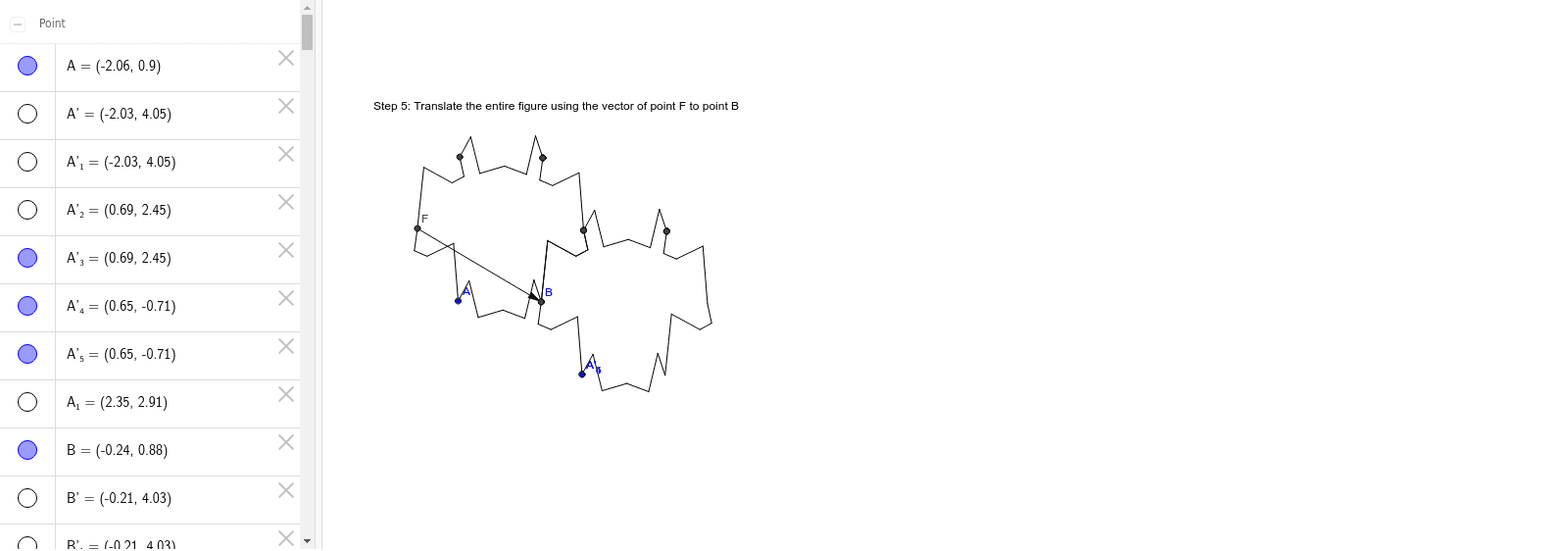
Step 5 Tessellation 2
Loading the math board and drawing, please wait…
In collections
Hexagon- Translation Tessellation (Monster)
This example demonstrates the process of a five-step tessellation. It involves geometric transformations and polygons. Using commands like Polygon, Segment, Vector, and Translate, complex tessellation patterns can be constructed. Suitable for high school geometry and math enthusiasts.
GeoGebra Commands & Parameters
Polygon(A, B, 6) → poly1, a, F, b, c, d, e, f, C, D, ESegment(A, G) → gSegment(G, H) → hSegment(H, I) → iSegment(I, J) → jSegment(J, K) → kSegment(K, B) → lVector(A, E) → uTranslate(A, u) → A'Translate(B, u) → B'Segment(A', B') → a'Translate(A, u) → A'_1Translate(G, u) → G'Segment(A'_1, G') → g'Translate(G, u) → G'_1Translate(H, u) → H'Segment(G'_1, H') → h'Translate(H, u) → H'_1Translate(I, u) → I'Segment(H'_1, I') → i'Translate(I, u) → I'_1Translate(J, u) → J'Segment(I'_1, J') → j'Translate(J, u) → J'_1Translate(K, u) → K'Segment(J'_1, K') → k'Translate(K, u) → K'_1Translate(B, u) → B'_1Segment(K'_1, B'_1) → l'Segment(A, L) → mSegment(L, M) → nSegment(M, N) → pSegment(N, F) → qVector(F, D) → vTranslate(F, v) → F'Translate(A, v) → A'_2Segment(F', A'_2) → f'Translate(A, v) → A'_3Translate(L, v) → L'Segment(A'_3, L') → m'Translate(L, v) → L'_1Translate(M, v) → M'Segment(L'_1, M') → n'Translate(M, v) → M'_1Translate(N, v) → N'Segment(M'_1, N') → p'Translate(N, v) → N'_1Translate(F, v) → F'_1Segment(N'_1, F'_1) → q'Segment(B, O) → rSegment(O, P) → sSegment(P, Q) → tSegment(A'_3, Q) → a_1Vector(B, F) → wTranslate(B, w) → B'_2Translate(C, w) → C'Segment(B'_2, C') → b'Translate(B, w) → B'_3Translate(O, w) → O'Segment(B'_3, O') → r'Translate(O, w) → O'_1Translate(P, w) → P'Segment(O'_1, P') → s'Translate(P, w) → P'_1Translate(Q, w) → Q'Segment(P'_1, Q') → t'Translate(A'_3, w) → RTranslate(Q, w) → Q'_1Segment(R, Q'_1) → b_1Vector(F, B) → u_1Translate(A, u_1) → A'_4Translate(G, u_1) → G'_2Segment(A'_4, G'_2) → g'_1Translate(G, u_1) → G'_3Translate(H, u_1) → H'_2Segment(G'_3, H'_2) → h'_1Translate(H, u_1) → H'_3Translate(I, u_1) → I'_2Segment(H'_3, I'_2) → i'_1Translate(I, u_1) → I'_3Translate(J, u_1) → J'_2Segment(I'_3, J'_2) → j'_1Translate(J, u_1) → J'_3Translate(K, u_1) → K'_2Segment(J'_3, K'_2) → k'_1Translate(K, u_1) → K'_3Translate(B, u_1) → B'_4Segment(K'_3, B'_4) → l'_1Translate(A'_1, u_1) → TTranslate(G', u_1) → G''Segment(T, G'') → g''Translate(G'_1, u_1) → UTranslate(H', u_1) → H''Segment(U, H'') → h''Translate(H'_1, u_1) → VTranslate(I', u_1) → I''Segment(V, I'') → i''Translate(I'_1, u_1) → WTranslate(J', u_1) → J''Segment(W, J'') → j''Translate(J'_1, u_1) → ZTranslate(K', u_1) → K''Segment(Z, K'') → k''Translate(K'_1, u_1) → A_1Translate(B'_1, u_1) → B_1Segment(A_1, B_1) → l''Translate(A, u_1) → A'_5Translate(L, u_1) → L'_2Segment(A'_5, L'_2) → m'_1Translate(L, u_1) → L'_3Translate(M, u_1) → M'_2Segment(L'_3, M'_2) → n'_1Translate(M, u_1) → M'_3Translate(N, u_1) → N'_2Segment(M'_3, N'_2) → p'_1Translate(N, u_1) → N'_3Translate(F, u_1) → F'_2Segment(N'_3, F'_2) → q'_1Translate(A'_3, u_1) → C_1Translate(L', u_1) → L''Segment(C_1, L'') → m''Translate(L'_1, u_1) → D_1Translate(M', u_1) → M''Segment(D_1, M'') → n''Translate(M'_1, u_1) → E_1Translate(N', u_1) → N''Segment(E_1, N'') → p''Translate(N'_1, u_1) → F_1Translate(F'_1, u_1) → G_1Segment(F_1, G_1) → q''Translate(B, u_1) → B'_5Translate(O, u_1) → O'_2Segment(B'_5, O'_2) → r'_1Translate(O, u_1) → O'_3Translate(P, u_1) → P'_2Segment(O'_3, P'_2) → s'_1Translate(P, u_1) → P'_3Translate(Q, u_1) → Q'_2Segment(P'_3, Q'_2) → t'_1Translate(A'_3, u_1) → H_1Translate(Q, u_1) → Q'_3Segment(H_1, Q'_3) → c_1Translate(B'_3, u_1) → I_1Translate(O', u_1) → O''Segment(I_1, O'') → r''Translate(O'_1, u_1) → J_1Translate(P', u_1) → P''Segment(J_1, P'') → s''Translate(P'_1, u_1) → K_1Translate(Q', u_1) → Q''Segment(K_1, Q'') → t''Translate(R, u_1) → R'Translate(Q'_1, u_1) → L_1Segment(R', L_1) → d_1Translate(D, u_1) → D'Translate(F', u_1) → F''Translate(B'_2, u_1) → M_1Translate(C', u_1) → C''
AI Drawing Prompt Reference
Draw a regular hexagon with vertices connected in order. From one side of the hexagon, construct a polyline path inward, connecting the two endpoints of that side to several interior points. Then, using a diagonal direction of the hexagon as a translation vector, translate the entire hexagon and its internal polyline once to create an adjacent copy. On another side of the hexagon, construct a second polyline path, and translate this part using another diagonal direction as the vector. The final result is a tessellation pattern with the original shape and its translated copies, all segments remaining parallel.
The prompt above was compiled from the original drawing commands and is for reference only.