
Step 4 Tessellation 2: Translational Tiling Construction
Loading the math board and drawing, please wait…
In collections
Hexagon- Translation Tessellation (Monster)
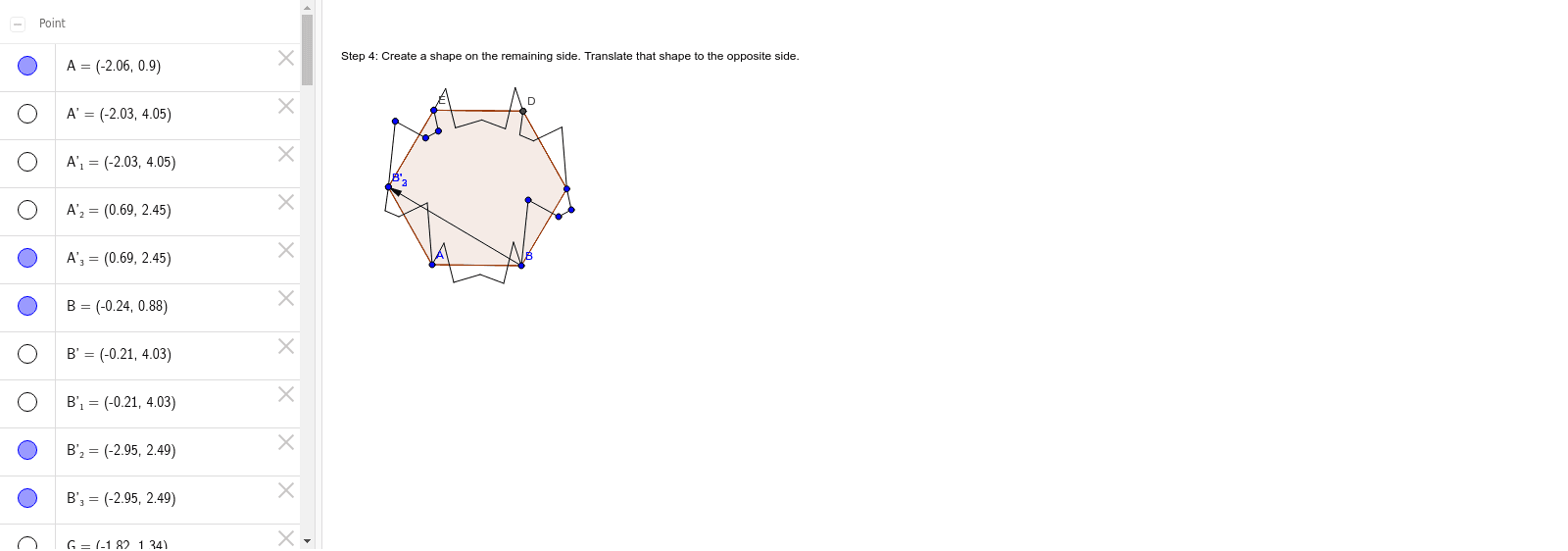
This example demonstrates how to construct a periodic tessellation by translating a base polygon (poly1) along multiple vectors, creating congruent copies that tile the plane. Core mathematical concepts include congruence transformations (translation), vectors, polygons, and the geometric structure of tessellations. Construction highlights: using GeoGebra commands such as Polygon to create the initial shape, Segment for edges, Vector to define translation directions, and Translate to replicate the polygon and associated objects (points, segments) into multiple congruent instances (e.g., A', B', G', etc.), forming a repeating pattern. Suitable for middle or high school geometry lessons on translations, congruence, and tessellations, as well as for pattern design in art.
GeoGebra Commands & Parameters
Polygon(A, B, 6) → poly1, a, F, b, c, d, e, f, C, D, ESegment(A, G) → gSegment(G, H) → hSegment(H, I) → iSegment(I, J) → jSegment(J, K) → kSegment(K, B) → lVector(A, E) → uTranslate(A, u) → A'Translate(B, u) → B'Segment(A', B') → a'Translate(A, u) → A'_1Translate(G, u) → G'Segment(A'_1, G') → g'Translate(G, u) → G'_1Translate(H, u) → H'Segment(G'_1, H') → h'Translate(H, u) → H'_1Translate(I, u) → I'Segment(H'_1, I') → i'Translate(I, u) → I'_1Translate(J, u) → J'Segment(I'_1, J') → j'Translate(J, u) → J'_1Translate(K, u) → K'Segment(J'_1, K') → k'Translate(K, u) → K'_1Translate(B, u) → B'_1Segment(K'_1, B'_1) → l'Segment(A, L) → mSegment(L, M) → nSegment(M, N) → pSegment(N, F) → qVector(F, D) → vTranslate(F, v) → F'Translate(A, v) → A'_2Segment(F', A'_2) → f'Translate(A, v) → A'_3Translate(L, v) → L'Segment(A'_3, L') → m'Translate(L, v) → L'_1Translate(M, v) → M'Segment(L'_1, M') → n'Translate(M, v) → M'_1Translate(N, v) → N'Segment(M'_1, N') → p'Translate(N, v) → N'_1Translate(F, v) → F'_1Segment(N'_1, F'_1) → q'Segment(B, O) → rSegment(O, P) → sSegment(P, Q) → tSegment(A'_3, Q) → a_1Vector(B, F) → wTranslate(B, w) → B'_2Translate(C, w) → C'Segment(B'_2, C') → b'Translate(B, w) → B'_3Translate(O, w) → O'Segment(B'_3, O') → r'Translate(O, w) → O'_1Translate(P, w) → P'Segment(O'_1, P') → s'Translate(P, w) → P'_1Translate(Q, w) → Q'Segment(P'_1, Q') → t'Translate(A'_3, w) → RTranslate(Q, w) → Q'_1Segment(R, Q'_1) → b_1
AI Drawing Prompt Reference
Draw a periodic tessellation starting with a regular hexagon as the base unit. Inside the hexagon, connect vertices to points on adjacent edges with straight segments. Then translate the entire hexagon and its internal segments along one direction to create a neighboring copy that shares an edge, forming a continuous row. Next, translate the shape along a second diagonal direction to generate another row that interlocks with the first, repeating the pattern to cover the plane. All translated copies remain congruent, showing only positional shifts, demonstrating translational symmetry.
The prompt above was compiled from the original drawing commands and is for reference only.