
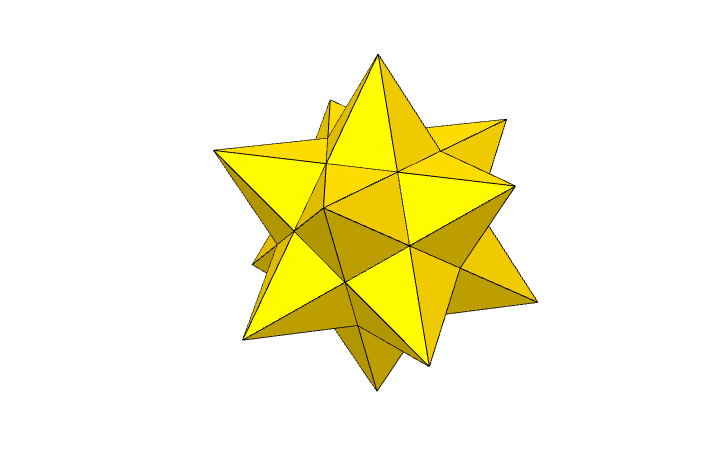
Stellated Dodecahedron
Loading the math board and drawing, please wait…
In collections
My 3D Collection
This example demonstrates the construction of a Stellated Dodecahedron using GeoGebra, a complex polyhedron formed by extending the vertices of a regular dodecahedron. Key mathematical concepts include solid geometry, trigonometric functions, matrix operations, and variance calculations. The construction involves commands and objects such as Point, Dodecahedron, Line, Intersect, and Pyramid, as summarized. Suitable for high school and advanced learners to explore polyhedron construction and spatial geometry relationships.
GeoGebra Commands & Parameters
Point(Circle[(((1 - sqrt(5)) * A) + ((3 + sqrt(5)) * B)) / 4, (Distance[A, B] * sqrt(10 + (2 * sqrt(5))) / 4), Segment[A, B]]) → CDodecahedron(A, B, C) → a, D, M, N, O, P, Q, R, S, T, faceABCDE, faceAEIOJ, E, faceABFKJ, faceBCGLF, faceCDHMG, faceDEINH, faceINSTO, faceJKPTO, faceFKPQL, faceGLQRM, faceHMRSN, facePQRST, F, edgeAE, edgeAB, edgeBC, edgeCD, edgeDE, edgeAJ, edgeEI, edgeIO, edgeJO, edgeJK, G, edgeFK, edgeBF, edgeFL, edgeGL, edgeCG, edgeGM, edgeHM, edgeDH, edgeHN, edgeIN, H, edgeNS, edgeST, edgeOT, edgePT, edgeKP, edgePQ, edgeLQ, edgeQR, edgeMR, edgeRS, I, J, K, LLine(K, P) → bLine(P, Q) → cLine(Q, L) → dLine(L, F) → eLine(F, K) → fLine(B, F) → gLine(B, C) → hLine(C, G) → iLine(G, L) → jLine(Q, R) → kLine(R, M) → lLine(M, G) → mLine(R, S) → nLine(S, T) → pLine(T, P) → qLine(T, O) → rLine(O, J) → sLine(J, K) → tLine(B, A) → a_1Line(A, J) → b_1Line(M, H) → c_1Line(H, N) → d_1Line(N, S) → e_1Line(N, I) → f_1Line(I, O) → g_1Line(I, E) → h_1Line(E, D) → i_1Line(D, C) → j_1Line(D, H) → k_1Intersect(j, h) → UIntersect(h_1, k_1) → VLine(A, E) → l_1Intersect(j_1, l_1) → WIntersect(a_1, t) → ZIntersect(l_1, s) → A_1Intersect(f, c) → B_1Intersect(q, t) → C_1Intersect(n, c_1) → D_1Intersect(k, m) → E_1Intersect(d, a_1) → F_1Intersect(d, b) → G_1Intersect(s, h_1) → H_1Pyramid(facePQRST, G_1) → o, face5, edge1, face4, face3, face1, face2, edge5, edge4, edge3, edge2Pyramid(faceINSTO, H_1) → u, face7, edge10, face6, face8, face10, face9, edge8, edge6, edge7, edge9Pyramid(faceHMRSN, E_1) → v, face11, edge13, face13, face15, face14, face12, edge11, edge12, edge14, edge15Pyramid(faceDEINH, W) → w, faceDEW, edgeIW, faceDHW, faceHNW, faceINW, faceEIW, edgeEW, edgeDW, edgeHW, edgeNWPyramid(faceGLQRM, D_1) → m_1, face16, edge18, face18, face20, face19, face17, edge16, edge17, edge19, edge20Pyramid(faceCDHMG, U) → n_1, faceCDU, edgeHU, faceCGU, faceGMU, faceHMU, faceDHU, edgeDU, edgeCU, edgeGU, edgeMUPyramid(faceBCGLF, F_1) → o_1, face21, edge24, face22, face24, face25, face23, edge22, edge21, edge23, edge25Pyramid(faceFKPQL, C_1) → p_1, face26, edge28, face28, face30, face29, face27, edge26, edge27, edge29, edge30Pyramid(faceJKPTO, B_1) → q_1, face32, edge32, face34, face35, face33, face31, edge31, edge33, edge35, edge34Pyramid(faceAEIOJ, Z) → r_1, faceAJZ, edgeOZ, faceAEZ, faceEIZ, faceIOZ, faceJOZ, edgeJZ, edgeAZ, edgeEZ, edgeIZPyramid(faceABCDE, V) → s_1, faceAEV, edgeDV, faceABV, faceBCV, faceCDV, faceDEV, edgeEV, edgeAV, edgeBV, edgeCVPyramid(faceABFKJ, A_1) → t_1, face36, edge38, face37, face40, face39, face38, edge37, edge36, edge39, edge40
AI Drawing Prompt Reference
Draw a Stellated Dodecahedron by extending the vertices of a regular dodecahedron to form a complex polyhedron. Start by constructing the basic shape of the dodecahedron, then extend lines from each vertex outward to create star-like protrusions. Pay attention to the intersections of lines and the faces formed, resulting in a polyhedron composed of multiple triangular pyramids and pentagonal faces.
The prompt above was compiled from the original drawing commands and is for reference only.