
Star-shaped Polygon Construction
Loading the math board and drawing, please wait…
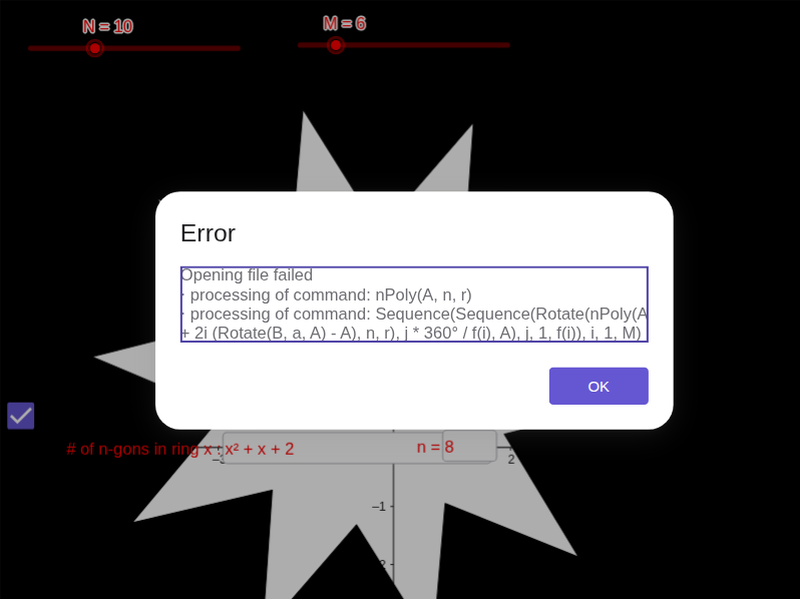
This GeoGebra example visually constructs star-shaped polygons using rotation, sequences, and geometric transformations. It demonstrates rotational symmetry and iterative polygon generation, covering core concepts such as polygonal construction, distance-based sequencing, and transformational geometry. The construction employs GeoGebra commands including Circle, Rotate, Join, Polygon, Distance, and Sequence, with interactive input controls for adjusting parameters. It is suitable for high school geometry, parametric modeling, and mathematical art exploration, helping learners connect transformational geometry with iterative sequence logic.
GeoGebra Commands & Parameters
Textfield(f) → InputBox1Circle(A, B) → cRotate(C, (180 * ° / N), A) → C'Join(Sequence[Rotate[{D, C'}, ((i * 360) * ° / N), A], i, 1, N]) → list2Polygon(list2) → poly1Distance(A, B) → rnPoly(A, n, r) → poly2Sequence(Sequence[Rotate[nPoly[A + ((2 * i) * (Rotate[B, a, A] - A)), n, r], ((j * 360) * ° / f(i)), A], j, 1, f(i)], i, 1, M) → list1Textfield(n) → InputBox2
AI Drawing Prompt Reference
Draw a star-shaped polygon by first creating a circle, then generating a series of rotated points and connecting them to show rotational symmetry. Create a base polygon based on a distance parameter, and use rotations and iterative sequences to generate a complex star pattern, with controls to adjust the shape and iteration count.
The prompt above was compiled from the original drawing commands and is for reference only.