
Standing Wave: First 5 Modes
Loading the math board and drawing, please wait…
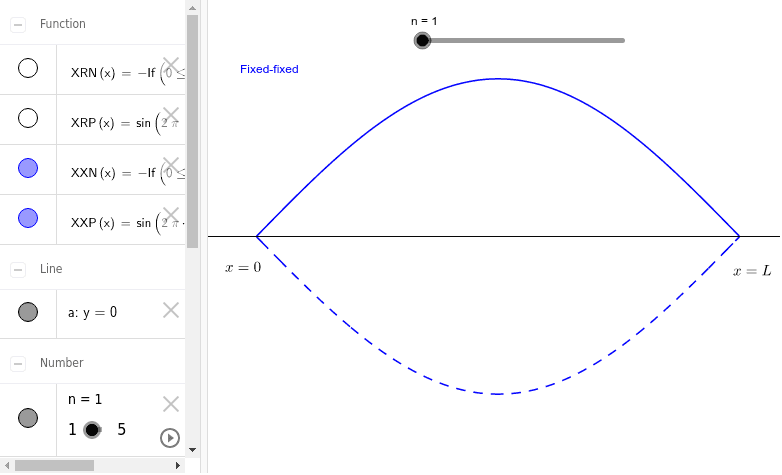
This example demonstrates the first five modes of a standing wave. A standing wave is a stable wave pattern formed under certain conditions, involving the principles of wave superposition. Using GeoGebra commands such as points and lines, the nodes and antinodes of the wave can be visually displayed. Suitable for high school physics and mathematics education, helping students understand the properties of waves and wave superposition.
GeoGebra Commands & Parameters
Point(XXP) → BLine(A, B) → a
AI Drawing Prompt Reference
Draw a diagram illustrating the first five modes of a standing wave. Include a horizontal baseline and a slanted line segment originating from a point on the baseline, representing a node or antinode position. The figure should clearly show the distribution of nodes (points with zero amplitude) and antinodes (points with maximum amplitude) through a combination of points and lines, demonstrating the superposition of waves. Keep the composition simple and suitable for high school physics education.
The prompt above was compiled from the original drawing commands and is for reference only.