
SSS Triangle Congruence Theorem: Dynamic Proof
Loading the math board and drawing, please wait…
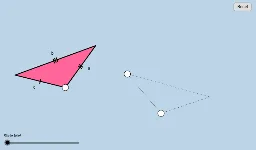
① This example dynamically demonstrates the proof of the SSS (Side-Side-Side) triangle congruence theorem, showing that if three corresponding sides of two triangles are equal, the triangles are congruent. ② Core mathematical concepts include triangle congruence, the SSS criterion, geometric transformations (translation, rotation, reflection), and vector operations. ③ Construction highlights: Using GeoGebra commands such as Circle, Intersect, Segment, Polygon, Point, Line, Angle, Dilate, Vector, Translate, Rotate, Mirror, Ray, Min, and CircleSector, the construction builds a base triangle and then applies transformations to move it onto another triangle, visually verifying congruence; key objects include points A, B, C, sides a, b, c, and auxiliary circles, segments, and polygons. ④ Suitable for middle school geometry (e.g., grades 8-9), this resource helps students grasp the intuitive basis of congruence criteria and serves as a classroom demonstration or self-exploration tool.
GeoGebra Commands & Parameters
Circle(A, a) → d_1Intersect(d_1, e) → B, CCircle(C, b) → fSegment(A, C) → gCircle(A, c) → kIntersect(k, f) → F, G, ,Segment(C, F) → hSegment(F, A) → iPolygon(A, C, F) → poly1, f_1, a_1, c_1Circle(D, i) → pPoint(p) → ESegment(D, E) → nCircle(D, g) → qCircle(E, h) → rIntersect(q, r, 2) → HSegment(D, H) → sSegment(H, E) → tLine(A, n) → g_1Point(g_1) → IAngle(I, A, F) → αDilate(A, If[0 < o ≤ 1, 1 - o, 0], D) → A'Vector(A, A') → uTranslate(F, u) → F'Translate(A, u) → A'_1Segment(F', A'_1) → i'Rotate(F', If[1 < o ≤ 2, ((-(o - 1)) * α), (-α)], D) → F''Rotate(A'_1, If[1 < o ≤ 2, ((-(o - 1)) * α), (-α)], D) → JSegment(F'', J) → i''Dilate(A, If[2 < o ≤ 3, 3 - o, 0], D) → A'_2Vector(A, A'_2) → vTranslate(A, v) → A'_3Translate(C, v) → C'Segment(A'_3, C') → g'Line(D, g) → h_1Point(h_1) → KAngle(H, D, K) → βRotate(A'_3, If[3 < o ≤ 4, ((-(o - 3)) * β), (-β)], D) → LRotate(C', If[3 < o ≤ 4, ((-(o - 3)) * β), (-β)], D) → C''Segment(L, C'') → g''Line(C, t) → i_1Point(i_1) → MAngle(M, C, F) → γDilate(C, If[4 < o ≤ 5, 5 - o, 0], C'') → C'_1Vector(C, C'_1) → wTranslate(C, w) → C'_2Translate(F, w) → F'_1Segment(C'_2, F'_1) → h'Rotate(C'_2, If[5 < o ≤ 6, ((-(o - 5)) * γ), (-γ)], C'') → NRotate(F'_1, If[5 < o ≤ 6, ((-(o - 5)) * γ), (-γ)], C'') → OSegment(N, O) → h''Line(F, C) → j_1Mirror(A, j_1) → A'_6Mirror(C, j_1) → C'_4Mirror(F, j_1) → F'_3Polygon(A'_6, C'_4, F'_3) → poly1'_1, f'_3, a'_6, c'_4Point(j_1) → SPoint(j_1) → TRay(C'_4, T) → k_1Ray(F'_3, S) → l_1Segment(A'_6, F'_3) → m_1Segment(A'_6, C'_4) → n_1Dilate(F, If[0 < d ≤ 1, 1 - d, 0], E) → F'_2Vector(F, F'_2) → u_1Translate(A'_6, u_1) → PTranslate(C'_4, u_1) → QTranslate(F'_3, u_1) → RPolygon(P, Q, R) → poly2, r_1, p_1, q_1Translate(A'_6, u_1) → UTranslate(C'_4, u_1) → VSegment(U, V) → s_1Translate(A'_6, u_1) → WTranslate(F'_3, u_1) → ZSegment(W, Z) → t_1Translate(C, u_1) → C'_3Translate(F, u_1) → F'_4Segment(C'_3, F'_4) → h'_1Translate(A'_6, u_1) → A_1Translate(F'_3, u_1) → B_1Segment(A_1, B_1) → e_1Line(E, k_1) → f_2Point(f_2) → C_1Angle(C'', E, C_1) → δRotate(P, If[1 < d ≤ 2, ((-(d - 1)) * δ), (-δ)], E) → P'Rotate(Q, If[1 < d ≤ 2, ((-(d - 1)) * δ), (-δ)], E) → Q'Rotate(R, If[1 < d ≤ 2, ((-(d - 1)) * δ), (-δ)], E) → R'Polygon(P', Q', R') → poly2', r', p', q'Rotate(A_1, If[1 < d ≤ 2, ((-(d - 1)) * δ), (-δ)], E) → D_1Rotate(B_1, If[1 < d ≤ 2, ((-(d - 1)) * δ), (-δ)], E) → E_1Segment(D_1, E_1) → g_2Rotate(U, If[1 < d ≤ 2, ((-(d - 1)) * δ), (-δ)], E) → U'Rotate(V, If[1 < d ≤ 2, ((-(d - 1)) * δ), (-δ)], E) → V'Segment(U', V') → h_2Rotate(C'_3, If[1 < d ≤ 2, ((-(d - 1)) * δ), (-δ)], E) → F_1Rotate(F'_4, If[1 < d ≤ 2, ((-(d - 1)) * δ), (-δ)], E) → G_1Segment(F_1, G_1) → i_2Polygon(D, C'', E) → poly3, e_2, d_2, c''Dilate(D, If[2.5 < d ≤ 3.5, 3.5 - d, 0], D_1) → D'Segment(D, D') → j_2Segment(E, C'') → k_2Min(c, k_2 / 2) → o_1Circle(D, (0.3 * o_1)) → c_2Intersect(c_2, i'') → H_1,Intersect(c_2, j_2) → I_1,CircleSector(D, I_1, H_1) → p_2Intersect(j_2, k_2) → J_1Polygon(D, D_1, E) → poly4, e_3, d_3, d_4Dilate(D, If[3.5 < d ≤ 4.5, 4.5 - d, 0], D_1) → D'_1Vector(D, D'_1) → v_1Translate(p_2, v_1) → q_2Angle(E, D_1, D) → εRotate(q_2, If[4.5 < d ≤ 5.5, ((d - 4.5) * (π - ε)), π - ε], D_1) → r_2Intersect(c_2, g'') → K_1, L_1CircleSector(D, K_1, I_1) → s_2Polygon(D, C'', D_1) → poly5, d_5, d_6, c''_1Dilate(D, If[6 < d ≤ 7, 7 - d, 0], D_1) → D'_2Vector(D, D'_2) → w_1Translate(s_2, w_1) → t_2Angle(D, D_1, C'') → ζRotate(t_2, If[7 < d ≤ 8, ((-(d - 7)) * (π - ζ)), (-(π - ζ))], D_1) → c_3Dilate(E, If[8.5 < d ≤ 9.5, 9.5 - d, 0], C'') → E'Segment(E, E') → l_2Segment(E, C'') → m_2Polygon(A, C, F) → poly6, f_3, a_2, c_4Polygon(D, C'', E) → poly7, e_4, d_7, c''_2
AI Drawing Prompt Reference
Create a dynamic diagram illustrating the Side-Side-Side (SSS) triangle congruence theorem. Start with a base triangle, then construct a second triangle with all three corresponding sides equal. Use transformations such as translation, rotation, and reflection to move the second triangle onto the first, visually demonstrating congruence. Include auxiliary circles, segments, and angle markers to highlight the equal sides and angles. The diagram should clearly show that when three sides match, the triangles are congruent.
The prompt above was compiled from the original drawing commands and is for reference only.