
G.GCO.7 SAS - Exercise 2
Loading the math board and drawing, please wait…
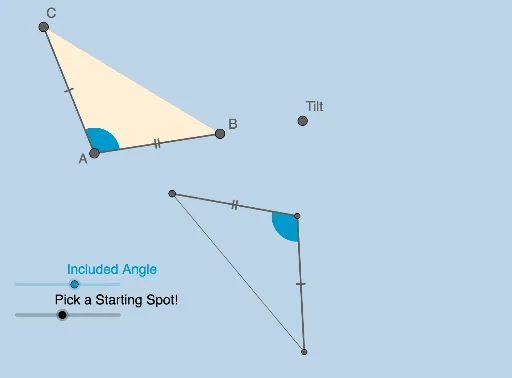
This GeoGebra example demonstrates how to prove triangle congruence using the SAS (Side-Angle-Side) theorem through transformational geometry. It focuses on the core concept of triangle congruence criteria and the use of rotations, translations, and symmetry in geometric proofs. The construction involves commands such as Ray, Rotate, Angle, Point, Polygon, Segment, Circle, Intersect, CircleSector, Vector, and Translate to create and manipulate triangles and their transformed copies. Key objects include points like B', C', and D', polygons poly1 and poly1', and various segments and angles that illustrate corresponding sides and angles. This exercise is suitable for middle or high school geometry classes, helping students visualize how SAS congruence can be established via transformations and reinforcing their understanding of geometric reasoning.
GeoGebra Commands & Parameters
Ray(A, B_1) → fRotate(B_1, α, A) → B'Angle(B_1, A, B') → βPoint(f) → BRay(A, B') → gPoint(g) → CPolygon(A, B, C) → poly1, h, i, jSegment(A, C) → kSegment(A, B) → lCircle(A, (0.2 * Min[k, l])) → cIntersect(c, f) → F,Intersect(c, k) → G,CircleSector(A, F, G) → dPoint(xAxis) → HVector(H, I) → uTranslate(A, u) → A'Translate(C, u) → D'Segment(A', D') → k'Translate(A, u) → A'_1Translate(B, u) → C'Translate(C, u) → D'_1Polygon(A'_1, C', D'_1) → poly1', d'_1, a'_1, c'Segment(D'_1, A'_1) → mSegment(C', A'_1) → nSegment(D'_1, C') → pCircle(A'_1, Radius[c]) → eIntersect(e, n, 1) → JIntersect(e, m, 1) → KCircleSector(A'_1, J, K) → qRotate(A, γ, L) → A'_2Rotate(B, γ, L) → C'_1Rotate(C, γ, L) → D'_2Polygon(A'_2, C'_1, D'_2) → poly1'_1, d'_2, a'_2, c'_1Segment(C'_1, A'_2) → rSegment(A'_2, D'_2) → sSegment(C'_1, D'_2) → tRotate(d, γ, L) → d'Vector(A'_2, D) → vTranslate(A'_2, v) → MTranslate(C'_1, v) → NTranslate(D'_2, v) → OPolygon(M, N, O) → poly2, o, m_1, n_1Translate(d', v) → d''Segment(N, M) → aSegment(M, O) → bSegment(N, O) → f_1
AI Drawing Prompt Reference
Draw a triangle and demonstrate its congruence through rotation and translation. Start by drawing a ray, then rotate it by an angle to get a second point, and connect these two points to form a triangle. Next, draw a circle with one side of the triangle as the radius, intersecting the ray at two points. Connect these points to the triangle's vertex to form another triangle. Finally, translate the first triangle along a certain direction to get an congruent triangle, and draw the corresponding sides and angles.
The prompt above was compiled from the original drawing commands and is for reference only.