
Proving Triangles Similar Using Geometric Transformations (Exercise 3) (1)
Loading the math board and drawing, please wait…
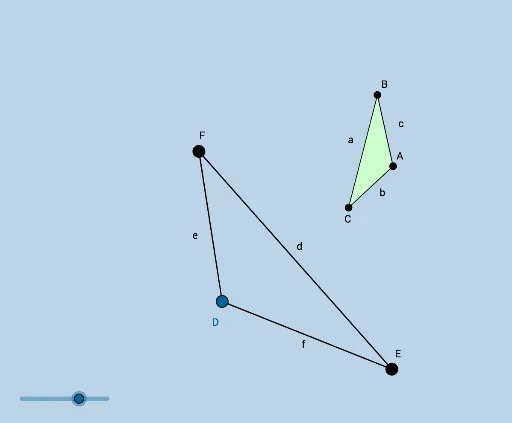
This GeoGebra example demonstrates how to prove two triangles are similar by applying geometric transformations such as translation, rotation, reflection, and dilation. The core mathematical concept is the similarity criteria for triangles, emphasizing that transformations preserve angles and scale side lengths proportionally. The construction uses commands like Ray, Segment, Polygon to create the original triangle; Rotate, Translate, Dilate to generate transformed copies; Angle to mark corresponding angles; Vector to indicate translation direction; and Point to place auxiliary vertices. Suitable for high school geometry lessons on similarity and transformations, and useful for interactive classroom demonstrations or student self-study.
GeoGebra Commands & Parameters
Ray(D, E) → f_2Rotate(E, (a_3 * π / 180), D) → B'Angle(E, D, B') → αRay(D, B') → gPoint(g) → FSegment(F, E) → dSegment(D, E) → fPolygon(D, E, F) → poly1, c_2, a_1, b_2Segment(D, F) → eAngle(F, E, D) → βVector(D_1, E_1) → uPolygon(D, E, F) → poly2, c_1, a_2, b_1Translate(D, u) → A'Translate(E, u) → B'_1Translate(F, u) → C'Polygon(A', B'_1, C') → poly2', c', a', b'_1Dilate(A', d_1, A') → A''Dilate(B'_1, d_1, A') → F_1Dilate(C', d_1, A') → CPolygon(A'', F_1, C) → poly2'', c'', a'', f_1Segment(A', C) → kSegment(C, F_1) → lSegment(F_1, A') → mRotate(A'', (e_1 * π / 180), C) → A'''Rotate(F_1, (e_1 * π / 180), C) → BRotate(C, (e_1 * π / 180), C) → C'''Polygon(A''', B, C''') → poly2''', c''', a_4, f'Rotate(A', (e_1 * π / 180), C) → ASegment(A, B) → cSegment(B, C) → aSegment(C, A) → b
AI Drawing Prompt Reference
Draw two similar triangles. First, create triangle DEF. Then, generate triangle D'E'F' using translation and rotation. Next, use similarity transformations to create triangle A'B'C'. Finally, generate triangle ABC through rotation. Remember to mark corresponding angles α and β, and the translation vector u.
The prompt above was compiled from the original drawing commands and is for reference only.