
Similar Triangles Exploration: Translation and Vector Construction
Loading the math board and drawing, please wait…
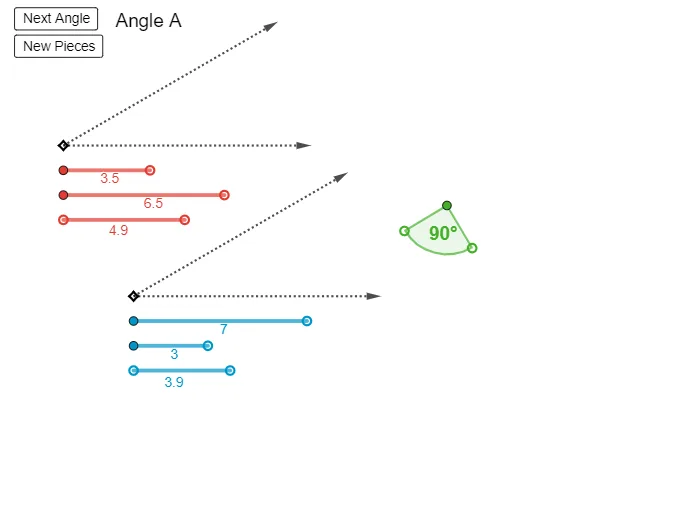
This example demonstrates how to construct similar triangles using translation and vector operations, and observe the relationships between corresponding sides and angles. The core mathematical concepts are the criteria and properties of similar triangles, including equal corresponding angles, proportional corresponding sides, and the preservation of shape under translation. Construction highlights: using GeoGebra commands such as Element, Translate, Point, Segment, Vector, and Angle, creating points R, A, B, C, and generating translated points A' and A'_1 via vectors, constructing multiple triangles and auxiliary segments (m1, m2, a, b, c, etc.), and marking corresponding angles with the angle tool. Suitable for 8th-grade students learning the definition and properties of similar triangles, and for teachers to demonstrate in class, helping students intuitively understand similarity under translation transformations.
GeoGebra Commands & Parameters
Element(l1, n) → gaTranslate(A, Vector[A, B]) → A'Translate(A + (1, 0), Vector[A, B]) → CTranslate(A, Vector[A, B]) → A'_1Translate(A + (cos(30°), sin(30°)), Vector[A, B]) → DPoint(Circle[E, a]) → KPoint(Circle[F, b]) → LSegment(E, K) → iSegment(F, L) → jSegment(G, M) → kPoint(Circle[H, c]) → NPoint(Circle[I, d]) → OSegment(H, N) → lSegment(I, O) → mSegment(J, P) → pVector(A, A + (o * (cos(ga), sin(ga)))) → gVector(A, A + (o, 0)) → fVector(B, B + (o * (cos(ga), sin(ga)))) → g'Vector(B, B + (o, 0)) → f'Point(Circle[R, 2]) → QPoint(Circle[R, 2]) → SAngle((2 * Q) - R, R, (2 * S) - R) → α
AI Drawing Prompt Reference
Draw a geometric figure with two similar triangles, where one triangle is obtained by translating the other along a vector. Start with a base triangle defined by three points, and label its sides. Then translate the entire triangle in a fixed direction to create a second triangle, preserving its shape. From corresponding vertices in both triangles, draw auxiliary segments and mark the corresponding angles as equal. Additionally, include an angle marker showing the relationship between corresponding angles. The overall figure demonstrates the similarity of triangles under translation, with proportional sides and equal angles.
The prompt above was compiled from the original drawing commands and is for reference only.