
Squaring the Octagon: Geometric Construction
Loading the math board and drawing, please wait…
In collections
geometriadinamica.es
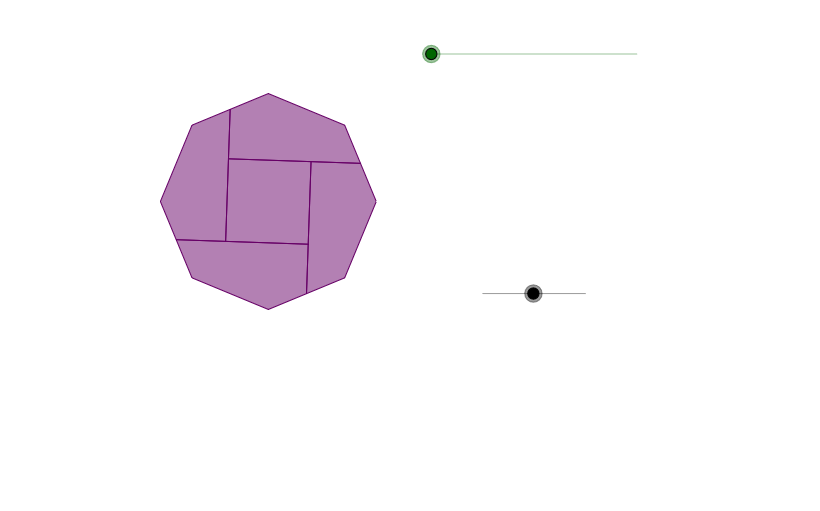
This example demonstrates the classic idea of “squaring the octagon” by using systematic geometric construction starting from an octagon and deriving key auxiliary measurements from circles and angle bisectors. The main mathematical concepts include polygon–circle geometry, angle bisection, midpoint and distance relationships, and the use of transformations to build symmetric configurations. Construction highlights: Intersect is used to create critical intersection points; Circle builds guiding circles; AngularBisector and LineBisector establish angle-halving lines; Midpoint locates required segment centers; Distance measures the metric quantities used in the construction; Polygon organizes the octagon and related polygonal structures; and Rotate, Translate, Mirror, Line, and Vector generate rotated/shifted/reflected helper elements to enforce symmetry and alignment. Suitable for high-school geometry, geometry-construction practice, and contest-oriented instruction on rigorous construction workflows.
GeoGebra Commands & Parameters
Intersect(xAxis, yAxis) → OCircle(O, escala) → cIntersect(c, yAxis) → A, BIntersect(c, xAxis) → C, DAngularBisector(D, O, A) → aAngularBisector(D, O, B) → bIntersect(c, b) → E, FIntersect(c, a) → G, HMidpoint(E, A) → IMidpoint(H, D) → JMidpoint(J, I) → KCircle(K, I) → dDistance(C, G) → LCircle(I, mr) → eIntersect(d, e, 2) → MPolygon(I, M, J, H, A) → P, i, m, j, h, a_1Line(A, H) → fLine(I, M) → gIntersect(f, g) → NAngle(A, N, I) → αRotate(I, β, N) → I'Rotate(M, β, N) → M'Rotate(J, β, N) → J'Rotate(H, β, N) → H'Rotate(A, β, N) → A'Polygon(I', M', J', H', A') → P', i', m', j', h', a'Vector(A', M) → uTranslate(I', v) → I''Translate(M', v) → M''Translate(J', v) → J''Translate(H', v) → H''Translate(A', v) → A''Polygon(I'', M'', J'', H'', A'') → P'', i'', m'', j'', h'', a''Mirror(M, O) → QCircle(O, Q) → pLineBisector(M, Q) → lIntersect(p, l) → R, SPolygon(M, S, Q, R) → T, m_1, s, q, r_1Mirror(I'', O) → I'''Mirror(M'', O) → M'''Mirror(J'', O) → J'''Mirror(H'', O) → H'''Mirror(A'', O) → A'''Polygon(I''', M''', J''', H''', A''') → P''', i''', m''', j''', h''', a'''Rotate(I'', γ, O) → I'''_1Rotate(M'', γ, O) → M'''_1Rotate(J'', γ, O) → J'''_1Rotate(H'', γ, O) → H'''_1Rotate(A'', γ, O) → A'''_1Polygon(I'''_1, M'''_1, J'''_1, H'''_1, A'''_1) → P'''_1, i'''_1, m'''_1, j'''_1, h'''_1, a'''_1Mirror(I'''_1, O) → I'''_1'Mirror(M'''_1, O) → M'''_1'Mirror(J'''_1, O) → J'''_1'Mirror(H'''_1, O) → H'''_1'Mirror(A'''_1, O) → A'''_1'Polygon(I'''_1', M'''_1', J'''_1', H'''_1', A'''_1') → P'''_1', i'''_1', m'''_1', j'''_1', h'''_1', a'''_1'
AI Drawing Prompt Reference
Draw a regular octagon and systematically construct a square from it using circles and angle bisectors. Start by drawing a circle centered at the origin, intersecting the axes at four points. Then, create angle bisectors from these points and find their intersections with the circle. Next, locate the midpoints of these intersections and use them to draw additional circles. Apply rotations and reflections to build symmetric helper shapes, ultimately forming a new octagon that demonstrates the relationship between the original and the derived square.
The prompt above was compiled from the original drawing commands and is for reference only.