
Square Construction with Similarity Transformation and Circles
Loading the math board and drawing, please wait…
In collections
Compass and Straightedge Constructions
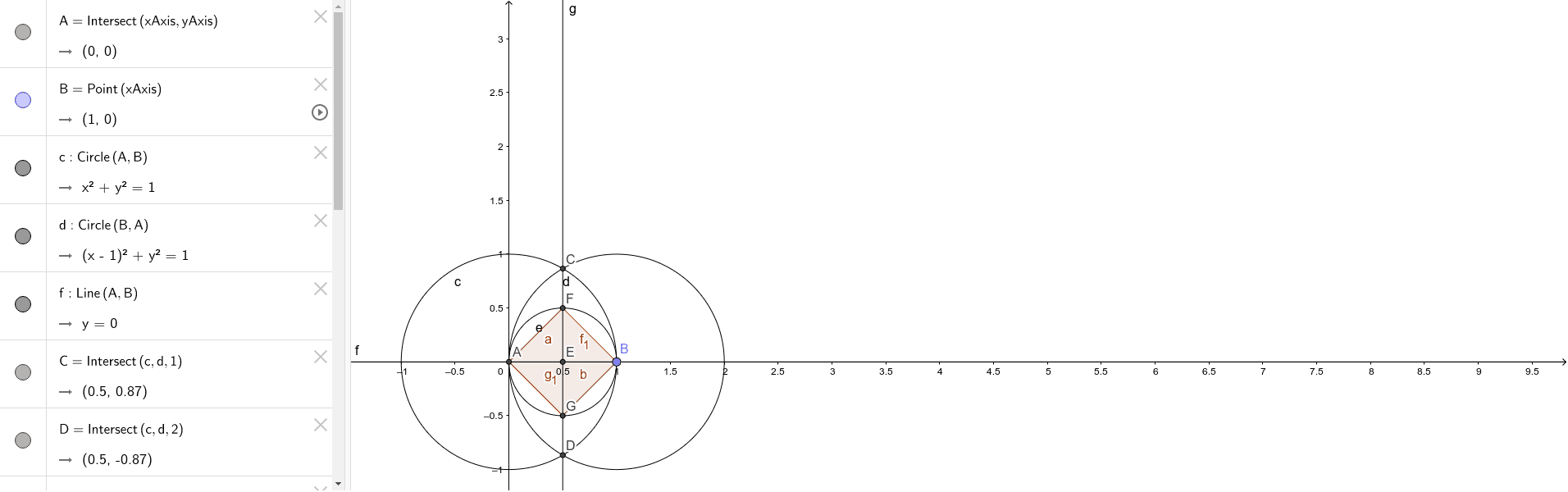
① This example demonstrates how to construct a square using intersections of circles, lines, and polygons, and then apply a similarity transformation (scaling) to generate related figures, showing dynamic geometric relationships. ② Core mathematical concepts include properties of squares, circle geometry, similarity transformations (homothety or scaling), and intersection relationships among points, lines, and circles. ③ Construction highlights: Based on the construction summary, GeoGebra commands such as Intersect, Point, Circle, Line, and Polygon are used, involving objects like points A, B, C, D, E, F, G, lines c, d, f, g, circle e, polygon poly1, and auxiliary objects a, b, f_1, g_1. The square vertices are determined via intersections, and a similarity transformation generates scaled copies. ④ Suitable for upper middle school or high school students to understand geometric construction, similarity transformations, and circle applications, and for teachers to demonstrate dynamic geometry.
GeoGebra Commands & Parameters
Intersect(xAxis, yAxis) → APoint(xAxis) → BCircle(A, B) → cCircle(B, A) → dLine(A, B) → fIntersect(c, d, 1) → CIntersect(c, d, 2) → DLine(C, D) → gIntersect(f, g) → ECircle(E, A) → eIntersect(e, g, 1) → FIntersect(e, g, 2) → GPolygon(A, F, B, G) → poly1, a, f_1, b, g_1
AI Drawing Prompt Reference
On a coordinate plane, start with the origin as one vertex and choose another point on the horizontal axis. Draw two equal circles centered at these two points with radius equal to the distance between them; they intersect at two points above and below the axis. Connect these two intersection points to form a vertical line, which meets the horizontal axis at its midpoint. Using this midpoint as center and the distance to the origin as radius, draw a circle that intersects the vertical line at two points. Connect the origin, the upper intersection, the point on the horizontal axis, and the lower intersection in order to form a square. Then apply a similarity transformation centered at the origin to scale the square down, producing a smaller similar square, while keeping all auxiliary circles and lines visible to show the dynamic geometric relationships.
The prompt above was compiled from the original drawing commands and is for reference only.