
Spinning Demonstration
Loading the math board and drawing, please wait…
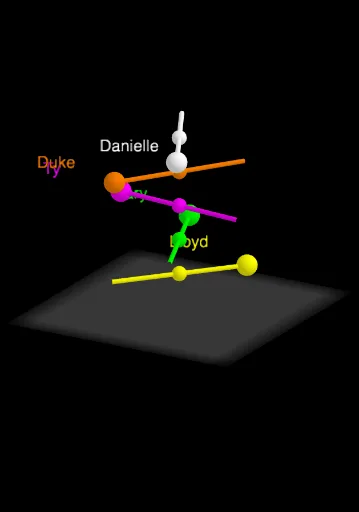
This example demonstrates dynamic changes and geometric relationships in rotational motion. It involves core math concepts like trigonometry, differential equations, integration, and parametric equations. Construction highlights include commands such as Intersect, Point, Circle, Rotate, Mirror, Segment, Cylinder, OrthogonalLine, and Plane. Suitable for high school students and math enthusiasts exploring spatial geometry and calculus applications.
GeoGebra Commands & Parameters
Intersect(xAxis, yAxis) → APoint(xAxis) → BCircle(A, B) → cRotate(B, α, A) → UnitSpeedRotate(B, (2 * α), A) → TwoRotate(B, (3 * α), A) → ThreeRotate(B, (4 * α), A) → FourRotate(B, (5 * α), A) → FiveMirror(Five, A) → Five'Segment(Five, Five') → fCylinder(c, (-(-5))) → a, d, bOrthogonalLine(Five, xOyPlane) → gOrthogonalLine(Three, xOyPlane) → hOrthogonalLine(Two, xOyPlane) → iOrthogonalLine(UnitSpeed, xOyPlane) → jOrthogonalLine(B, xOyPlane) → kOrthogonalLine(Four, xOyPlane) → lPoint(zAxis) → CPoint(zAxis) → DPoint(zAxis) → EPoint(zAxis) → FPoint(zAxis) → GPlane(F, xOyPlane) → ePlane(E, xOyPlane) → mPlane(D, xOyPlane) → nPlane(C, xOyPlane) → oIntersect(j, d, 1) → DaniellePoint(i) → DukeIntersect(h, m) → TyIntersect(l, n) → GaryIntersect(g, o) → LloydMirror(Danielle, G) → H'Mirror(Duke, F) → I'Mirror(Ty, E) → J'Mirror(Gary, D) → K'Mirror(Lloyd, C) → L'Segment(Danielle, H') → pSegment(Duke, I') → qSegment(Ty, J') → rSegment(Gary, K') → sSegment(Lloyd, L') → tSegment(A, UnitSpeed) → f_1Segment(A, B) → g_1
AI Drawing Prompt Reference
Create a spinning demonstration with a circle and a point rotating around its center. Start by drawing the intersection of the x-axis and y-axis as point A, then take point B on the x-axis. Draw circle c with A and B as center and radius. Rotate point B around A to form points like UnitSpeed, Two, Three, Four, and Five, and mirror Five to get Five'. Connect Five and Five' to form line segment f. Draw a cylinder with c as the base and height -5. Draw perpendicular lines from each rotating point to the xOy plane, such as g, h, i, j, k, and l. Take five points C, D, E, F, and G on the z-axis and draw planes e, m, n, and o through them in the xOy plane. Finally, connect each rotating point and its mirrored point with line segments, such as Danielle and H', Duke and I', Ty and J', Gary and K', Lloyd and L', and A and UnitSpeed, A and B.
The prompt above was compiled from the original drawing commands and is for reference only.