
Spider Geometry: Geodesics on a Prism
Loading the math board and drawing, please wait…
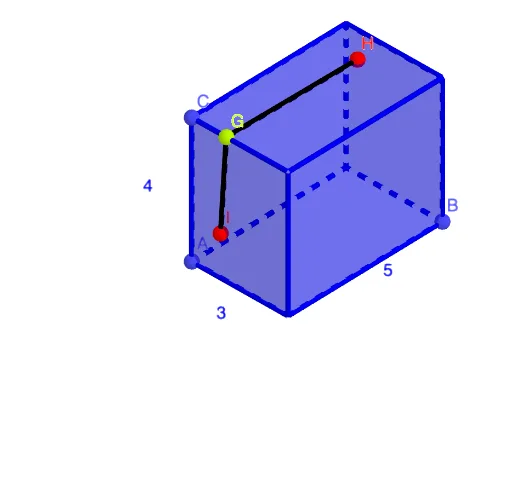
① This example demonstrates the construction of a geodesic (shortest path) on the surface of a prism, visualized through a spider's crawling path, and its unfolding into a net. ② Core mathematical concepts include solid geometry (prisms), geodesics, surface nets, and the roles of ellipses, parabolas, and cosine functions in path analysis. ③ Construction highlights: using GeoGebra commands such as Polygon, Prism, Point, PointIn, Segment, and Net to build the prism and its net; interactive elements include a button (button1) and text objects (text1, text2); key objects include prism vertices A, B, C, D, E, F, faces face1 through face4, edges edgeAC, edgeBE, etc., and auxiliary points G, H, I, J, K with segments h, i, j, k, d, e. ④ Suitable for high school and above, useful for teaching solid geometry, mathematical modeling, or exploring shortest-path problems, and as an advanced GeoGebra construction example.
GeoGebra Commands & Parameters
Polygon(A, (x(B), y(A)), B, (x(A), y(B))) → q1, a, f, b, gPrism(q1, C) → c, D, edge1, edgeBE, edge2, edgeCD, edgeDE, edgeEF, edgeCF, E, F, face1, face3, face4, face2, faceCDEF, edgeACPoint(c) → GPointIn(faceCDEF) → HPointIn(face1) → ISegment(H, G) → hSegment(G, I) → iPointIn(q1) → JPoint(c) → KSegment(G, K) → jSegment(K, J) → kNet(c, o) → l, L, U, V, W, Z, A_1, faceLMNO, faceLMQP, faceMNSR, faceNOUT, faceLOVW, M, face5, edgeLM, edgeMN, edgeNO, edgeLO, edgeLP, edgePQ, edgeMQ, edgeMR, edgeRS, N, edgeNS, edgeNT, edgeTU, edgeOU, edgeOV, edgeVW, edgeLW, edgeQZ, edge4, edge3, O, P, Q, R, S, TNet(Pyramid[q1, I], o) → p, C_1, face6, face8, face9, face7, edge5, edge9, edge12, edge6, edge7, edge10, D_1, edge11, edge13, edge14, edge15, edge16, edge8, E_1, F_1, G_1, H_1, I_1, J_1, face10Net(Pyramid[q1, G], o) → q, K_1, face11, face13, face14, face12, edge17, edge21, edge24, edge18, edge19, edge22, L_1, edge23, edge25, edge26, edge27, edge28, edge20, M_1, N_1, O_1, P_1, Q_1, R_1, face15Net(Pyramid[q1, K], o) → r, S_1, face16, face18, face19, face17, edge29, edge33, edge36, edge30, edge31, edge34, T_1, edge35, edge37, edge38, edge39, edge40, edge32, U_1, V_1, W_1, Z_1, A_2, B_2, face20Net(Pyramid[q1, H], o) → s, G_2, face21, face23, face24, face22, edge41, edge45, edge48, edge42, edge43, edge46, H_2, edge47, edge49, edge50, edge51, edge52, edge44, I_2, J_2, K_2, L_2, M_2, N_2, face25Segment(Hn, Gn) → tSegment(Gn, In) → f_1
AI Drawing Prompt Reference
Draw a prism with a spider's crawling path on its surface representing geodesics, and unfold it into a net. The path should traverse the prism's faces, connecting key points with segments, and include auxiliary lines. Highlight the prism's vertices, faces, and edges, and show the net formed by unfolding the path, demonstrating geometric construction and shortest path concepts.
The prompt above was compiled from the original drawing commands and is for reference only.