
Sphere Volume and Surface Area Dynamic Demonstration by GeoGebra Materials Team
Loading the math board and drawing, please wait…
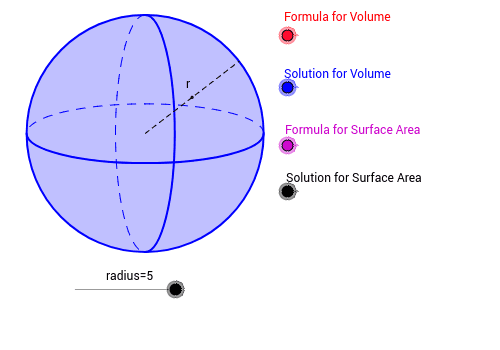
This GeoGebra example dynamically demonstrates the volume and surface area formulas of a sphere, using rotation, dilation, and interactive sliders to visualize the 3D construction. Core mathematical concepts include the sphere volume formula V=4/3πr³, surface area formula S=4πr², rotational solids, scaling, and parameter control. Construction details: commands such as Circle, Point, Arc, Rotate, Segment, Midpoint, and If are used to build cross-sections and rotation axes, with sliders adjusting the radius and updating numerical solutions for volume and surface area in real time. Suitable for middle school geometry, high school solid geometry, and university introductory courses, as well as for teachers creating interactive lessons to explore the derivation and geometric meaning of sphere formulas.
GeoGebra Commands & Parameters
Circle(P, R) → ePoint(e) → BArc(c, 3.141592653589793, 0) → fRotate(c, 90*°, P) → dRotate(R, 90*°, P) → DRotate(L, 90*°, P) → EArc(Rotate[c, 90*°, P], 3.141592653589793, 0) → gSegment(P, B) → aMidpoint(P, B) → CIf(VolumeFormula ≟ 1, A) → IIf(VolumeSolution ≟ 1, F) → JIf(SurfaceAreaFormula ≟ 1, G) → KIf(SurfaceAreaSolution ≟ 1, H) → M
AI Drawing Prompt Reference
Draw a 3D sphere with dynamic demonstration of its volume and surface area formulas. Start with a circle centered at a fixed point with a variable radius as the great circle of the sphere. Draw a radius segment from the center to a point on the circle, and mark its midpoint. Rotate the great circle 90 degrees around the center to create a perpendicular great circle, and draw a semicircular arc on it to form latitude and longitude lines. Add three interactive sliders: one for radius, one to toggle the volume formula display, and one to toggle the surface area formula display. When enabled, show the formulas V=4/3πr³ and S=4πr² with real-time numerical updates. The result is an interactive solid geometry visualization for exploring rotational solids and formula derivation.
The prompt above was compiled from the original drawing commands and is for reference only.