
Special Similar Triangles Case 2
Loading the math board and drawing, please wait…
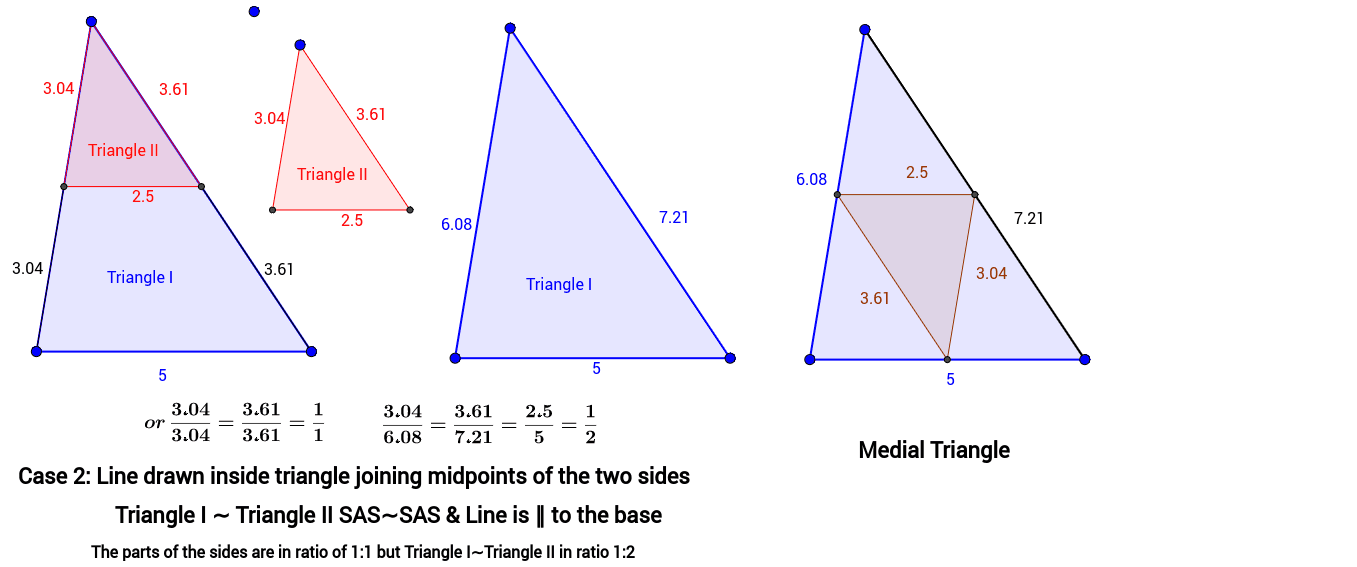
This example demonstrates the construction and properties of special similar triangles, involving core math concepts like similar triangles, isosceles triangles, and function graphs (power, quadratic, logarithmic functions). It uses GeoGebra commands such as Polygon, Midpoint, and Segment. Suitable for high school mathematics teaching and function graphing learning.
GeoGebra Commands & Parameters
Polygon(H_2, F_3, G_3) → poly2_1, g_2, h_2, f_2Midpoint(H_2, F_3) → I_1Midpoint(G_3, H_2) → J_1Segment(I_1, J_1) → l_2Segment(H_2, I_1) → m_2Segment(H_2, F_3) → n_2Segment(H_2, J_1) → p_2Segment(H_2, G_3) → q_2Polygon(H_2, I_1, J_1) → poly5_2, j_1, h_3, i_1Polygon(H_3, F_4, G_4) → poly2_3, g_3, h_5, f_3Segment(H_3, F_4) → n_1Segment(H_3, G_4) → q_1Segment(I_1, F_3) → t_2Segment(J_1, G_3) → t_1Polygon(H_1, F_1, G_1) → poly2_2, g_1, h_1, f_1Midpoint(H_1, F_1) → I_3Midpoint(G_1, H_1) → J_3Segment(H_1, F_1) → n_3Segment(H_1, G_1) → q_3Polygon(H_4, F_5, G_5) → poly2_4, g_4, h_6, f_4Midpoint(H_4, F_5) → I_4Midpoint(G_5, H_4) → J_4Segment(H_4, F_5) → n_4Segment(H_4, G_5) → q_4Midpoint(H_4, F_5) → K_1Midpoint(G_5, F_5) → L_1Midpoint(G_5, H_4) → M_1Polygon(L_1, M_1, K_1) → poly3_1, k_1, l_3, m_3Polygon(H_5, F_6, G_6) → poly2_5, g_5, h_7, f_5Midpoint(H_5, F_6) → I_5Midpoint(G_6, H_5) → J_5Segment(I_5, J_5) → l_4Segment(H_5, I_5) → m_4Segment(H_5, F_6) → n_5Segment(H_5, J_5) → p_3Segment(H_5, G_6) → q_5Polygon(H_5, I_5, J_5) → poly5_3, j_3, h_8, i_3Segment(I_5, F_6) → t_4Segment(J_5, G_6) → t_3Polygon(H_6, F_7, G_7) → poly2_6, g_6, h_{10}, f_6Midpoint(H_6, F_7) → I_6Midpoint(G_7, H_6) → J_6Segment(I_6, J_6) → l_5Segment(H_6, I_6) → m_5Segment(H_6, F_7) → n_6Segment(H_6, J_6) → p_4Segment(H_6, G_7) → q_6Polygon(H_6, I_6, J_6) → poly5_4, j_4, h_9, i_4Segment(I_6, F_7) → t_5Segment(J_6, G_7) → t_6Polygon(H_7, F_8, G_8) → poly2_7, g_7, h_{11}, f_7Midpoint(H_7, F_8) → I_2Midpoint(G_8, H_7) → J_2Segment(I_2, J_2) → l_1Segment(H_7, I_2) → m_1Segment(H_7, F_8) → n_7Segment(H_7, J_2) → p_1Segment(H_7, G_8) → q_7Polygon(H_7, I_2, J_2) → poly5_1, j_2, h_4, i_2Segment(I_2, F_8) → t_8Segment(J_2, G_8) → t_7Segment(I_1, F_3) → fSegment(J_1, G_3) → g