
Special Parallelograms by Sébastien Vieilhescazes
Loading the math board and drawing, please wait…
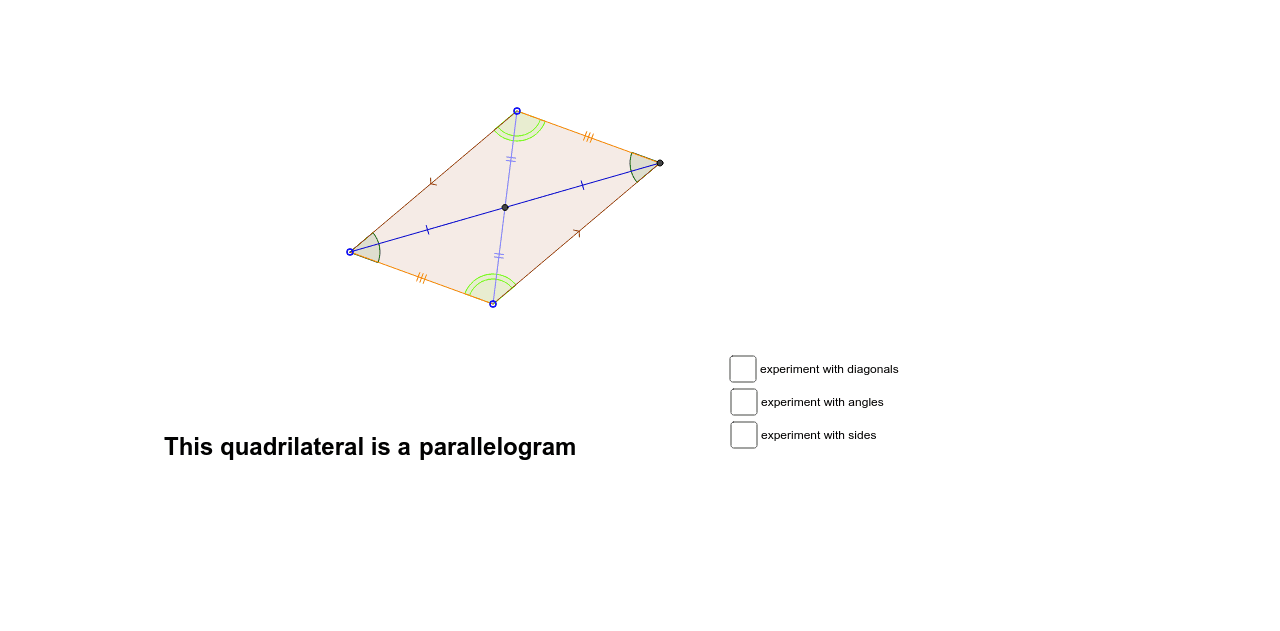
This example demonstrates the geometric relationships and properties of parallelograms, rectangles, rhombuses, and squares. It involves core mathematical concepts including parallelograms, quadrilateral classification, rectangles, rhombuses, squares, vectors, slopes, and triangles. The construction uses GeoGebra commands and objects like Line, Intersect, OrthogonalLine, Polygon, Segment, Circle, Angle, Vector, and Translate as outlined in the summary. It is suitable for high school mathematics education, helping students understand the criteria and properties of special parallelograms, as well as the application of vectors and geometric transformations.
GeoGebra Commands & Parameters
Line(A, B) → aLine(A, C) → bLine(C, a) → cLine(B, b) → dIntersect(c, d) → DOrthogonalLine(C, a) → eOrthogonalLine(D, a) → fPolygon(C, A, B, D) → poly1, c_1, a_1, b_1, d_1Segment(A, D) → gSegment(B, C) → hIntersect(g, h) → ECircle(E, C) → kCircle(E, D) → pOrthogonalLine(E, h) → iOrthogonalLine(E, g) → jSegment(A, E) → lSegment(E, D) → mSegment(E, B) → nSegment(E, C) → qSegment(A, E) → rSegment(E, D) → sAngle(C, D, B) → αAngle(D, B, A) → βAngle(B, A, C) → γAngle(A, C, D) → δCircle(A, ray) → tIntersect(t, b, 2) → FIntersect(t, a, 2) → GVector(A, F) → uTranslate(G, u) → G'Polygon(A, G, G', F) → poly2, a_2, g_1, g', f_1Vector(F, C) → vVector(G, B) → wTranslate(A, v) → A'Translate(G, v) → G'_1Translate(G', v) → G''Translate(F, v) → F'Polygon(A', G'_1, G'', F') → poly2', a', g'_1, g'', f'Translate(A, w) → A'_1Translate(G, w) → G'_2Translate(G', w) → G''_1Translate(F, w) → F'_1Polygon(A'_1, G'_2, G''_1, F'_1) → poly2'_1, a'_1, g'_2, g''_1, f'_1Translate(A', w) → A''Translate(G'_1, w) → HTranslate(G'', w) → G'''Translate(F', w) → F''Polygon(A'', H, G''', F'') → poly2'', a'', h_1, g''', f''Vector(G'_2, F') → u_1Translate(H, u_1) → H'Segment(C, A) → e_1Segment(B, D) → i_1OrthogonalLine(A, c_1) → l_1Circle(B, D) → q_1
AI Drawing Prompt Reference
Draw a parallelogram and show how it can be constructed into a rectangle, rhombus, and square. Start by drawing two parallel lines and then two more parallel lines to form a quadrilateral. Find the intersection of the diagonals and draw the sides of the square, rhombus, and rectangle. Use vectors to represent the diagonals and demonstrate how to obtain new parallelograms by translating the vectors. Finally, emphasize the geometric relationships with circles and angle markings.
The prompt above was compiled from the original drawing commands and is for reference only.