
Solving an Exponential Equation Example by Walch Education
Loading the math board and drawing, please wait…
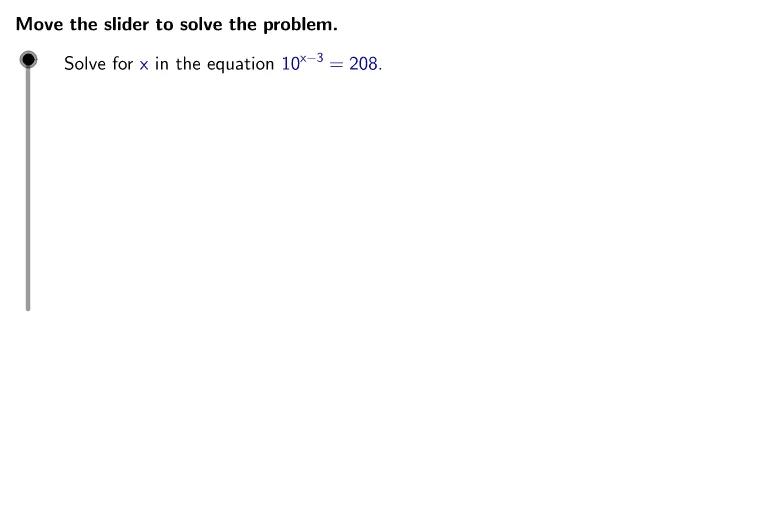
This example demonstrates how to solve the exponential equation 10^(x-3) = 208 using GeoGebra, including step-by-step solutions. Key math concepts involved are exponential equations and logarithms. GeoGebra commands and objects used in construction include LaTeX, Corner, stepMax, stepper, steps, counter, RandomizationText, Original, Randomized, A, B, xmin, xmax, ymin, ymax, button1, base, subtract, constant, text9, Problem, text1, text4, text5, text6, ans, finalans, text10, text11, text2_1, text3_1, text2_2, text3_2, text3, text2_3, text3_3, ans_1, text2_5, text3_4, text8, text0, text12. Suitable for middle school and above mathematics teaching and self-learning.
GeoGebra Commands & Parameters
LaTeX(steps) → counterLaTeX("\text{Use the buttons below to return to the original problem or}\cr\text{randomly generate a similar practice problem.}") → RandomizationTextCorner(1) → ACorner(3) → BLaTeX((("\text{Add }\textcolor{#000099}{" * subtract) * "}\text{ to both sides.}")) → text9LaTeX((((((("\text{Solve for }\textcolor{#000099}{x}\text{ in the equation }\textcolor{#000099}{" * base) * "^{x-") * subtract) * "}=") * constant) * "}.")) → ProblemLaTeX("\text{Notice that }\textcolor{#000099}{x}\text{ is in the exponent. In order to extract }\textcolor{#000099}{x}\text{ from the}\cr\text{argument of any function, apply the inverse of the function to both sides of the}\cr\text{equation.") → text1LaTeX((((((("\textcolor{#000099}{" * base) * "^{x-") * subtract) * "}=") * constant) * "}")) → text4LaTeX((("\text{Take the logarithm base }\textcolor{#000099}{" * base) * "}\text{ both sides.}")) → text5LaTeX((((((((((("\textcolor{#000099}{log_{" * base) * "}\left(") * base) * "^{x-") * subtract) * "}\right)=log_{") * base) * "}(") * constant) * ")}")) → text6LaTeX((("\textcolor{#000099}{x\approx" * finalans) * "}")) → text10LaTeX((((((((("\text{The value of }\textcolor{#000099}{x}\text{ in the exponential equation }\textcolor{#000099}{" * base) * "^{x-") * subtract) * "}=") * constant) * "}\text{ is approximately }\textcolor{#000099}{") * finalans) * "}.")) → text11LaTeX("\textcolor{#000099}{y=a^x}") → text2_1LaTeX("\text{General form of an exponential equation}") → text3_1LaTeX("\textcolor{#000099}{\log_{a}(y)=x}") → text2_2LaTeX("\text{Rewrite in logarithmic form.}") → text3_2LaTeX("\text{Given exponential equation}") → text3LaTeX((((((("\textcolor{#000099}{\log_{(" * base) * ")}(") * constant) * ")=(x-") * subtract) * ")}")) → text2_3LaTeX("\text{Substitute.}") → text3_3LaTeX((((((("\textcolor{#000099}{\log_{(" * base) * ")}(") * constant) * ")=(x-") * subtract) * ")}")) → text2_5LaTeX("\text{Logarithmic form of the original equation}") → text3_4LaTeX((((("\textcolor{#000099}{(" * ans) * ")\approx x-") * subtract) * "}")) → text8LaTeX("\text{Move the slider to solve the problem.}") → text0LaTeX("\text{An exponential equation of the form }\textcolor{#000099}{y=a^x}\text{ can be rewritten }\cr\text{as a logarithmic equation of the form }\textcolor{#000099}{\log_{a}(y)=x}.") → text2LaTeX((((((((((((("\text{The exponential equation }\textcolor{#000099}{" * base) * "^{x-") * subtract) * "}=") * constant) * "}\text{ can be rewritten as the }\cr\text{logarithmic equation }\textcolor{#000099}{\log_{(") * base) * ")}(") * constant) * ")=(x-") * subtract) * ")}.")) → text2_4LaTeX("\text{Find the common logarithm with}\cr\text{a calculator and substitute.}") → text7
AI Drawing Prompt Reference
Create a visual representation of solving the exponential equation 10^(x-3) = 208, including step-by-step solutions and key mathematical concepts. The graphic should display the exponential equation, its logarithmic form, and textual explanations of the solution steps. Start with the original equation, then show the step-by-step process of applying logarithms to both sides, and conclude with the approximate solution. Include illustrations of the exponential function y=a^x and the logarithmic function log_a(y)=x, along with explanations of their relationship.
The prompt above was compiled from the original drawing commands and is for reference only.