
Solid with Equilateral Triangle Cross-Sections Perpendicular to x-Axis
Loading the math board and drawing, please wait…
In collections
Calculus Concepts
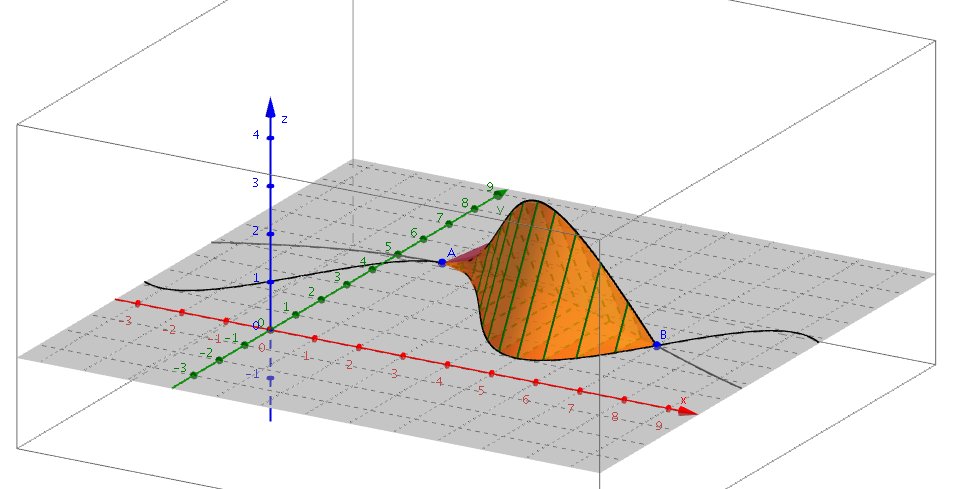
This applet demonstrates a three-dimensional solid formed by erecting equilateral triangles on cross-sections perpendicular to the x-axis. As you move along the x-axis, each cross-section is an equilateral triangle whose side length is determined by the vertical distance between two functions f and g, creating a smooth, symmetric solid. The core mathematical concepts include the cross-section method for computing volumes in calculus, properties of equilateral triangles, and the connection between function graphs and solid geometry. Construction highlights: the GeoGebra commands Surface, Sequence, and CurveCartesian are used to generate the surface, a series of triangular cross-sections, and boundary curves, respectively. Objects such as f, g, A, B, a, list1, b, d, and e control parameters and dynamic updates. This is suitable for high school to university students learning calculus, solid geometry, or 3D modeling, providing an intuitive visualization of volume via cross-sections and spatial construction.
GeoGebra Commands & Parameters
Surface(t, (u * g(t)) + ((1 - u) * f(t)), 0, t, 1, 7, u, 0, 1) → aSequence(Polygon[(a, f(a), 0), (a, g(a), 0), (a, (g(a) + f(a)) / 2, (sqrt(3) / 2 * (g(a) - f(a))))], a, 1, 7, 0.5) → list1CurveCartesian(t, (f(t) + g(t)) / 2, (sqrt(3) / 2 * (g(t) - f(t))), t, 1, 7) → bSurface(t, ((1 - u) * f(t)) + (u * (f(t) + g(t)) / 2), ((u * sqrt(3) / 2) * (g(t) - f(t))), t, 1, 7, u, 0, 1) → dSurface(t, (u * g(t)) + ((1 - u) * (f(t) + g(t)) / 2), (((1 - u) * sqrt(3) / 2) * (g(t) - f(t))), t, 1, 7, u, 0, 1) → e
AI Drawing Prompt Reference
Create a 3D solid formed by erecting equilateral triangles perpendicular to the x-axis. First, plot two functions f and g. Then, create equilateral triangular cross-sections at intervals of 0.5 units along the x-axis, with side lengths determined by the vertical distance between f and g. Use these triangles to construct the surface of the solid, and finally, draw the midpoint curve of f and g and the boundary curves of the solid.
The prompt above was compiled from the original drawing commands and is for reference only.