
Snell's Law with Vectors
Loading the math board and drawing, please wait…
In collections
Light
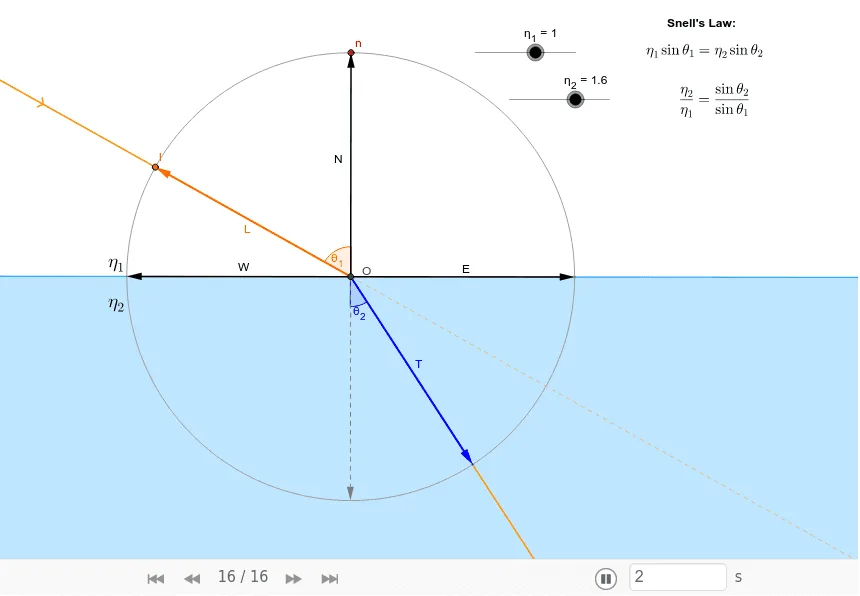
This example demonstrates Snell's Law using vector equations, showing how light changes its path when passing from one medium to another. Key mathematical concepts include vectors, angles, and refractive index. It uses Circle, Vector, Line, Segment, and Angle commands in GeoGebra for construction. Suitable for high school physics and math education to help students understand the principle of light refraction.
GeoGebra Commands & Parameters
Circle(O, 1) → cPoint(c) → nVector(O, n) → NVector(O, prp * N) → WVector(-prp * N) → EPoint(c) → lVector(O, l) → LLine(l, L) → bPoint(b) → SSegment(S, l) → dAngle(L, Vector[λ * N]) → θ_1Ray(O, T) → fPoint(t, Vector[1.5 * T]) → CSegment(t, C) → gAngle(Vector[-λ * N], T) → θ_2Point(O, R) → rRay(O, R) → hPoint(r, Vector[1.5 * R]) → ASegment(r, A) → i
AI Drawing Prompt Reference
Draw a refraction diagram where light enters from one medium to another. Start by drawing a circle and selecting a point on it as the incidence point. Then, draw the incident and refracted rays, and label the angles of incidence and refraction. Use vectors to represent the direction of the rays and adjust their lengths and directions to simulate light propagation in different media.
The prompt above was compiled from the original drawing commands and is for reference only.