
Slope Discovery: Dynamic Construction of Non-Vertical Lines
Loading the math board and drawing, please wait…
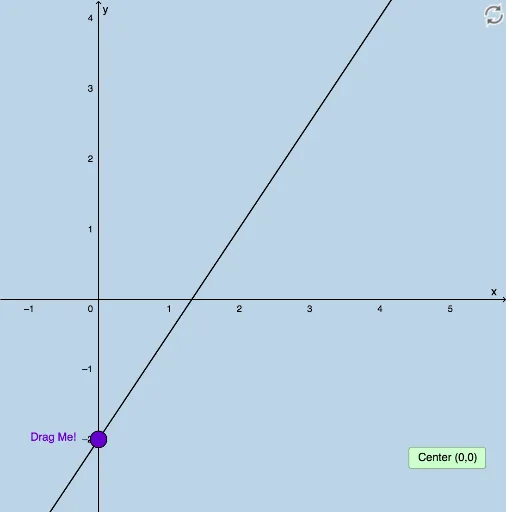
This example demonstrates the dynamic construction of the equation of a non-vertical line using geometric tools. Key mathematical concepts include slope, vector transformations, and the geometric interpretation of linear equations. Construction involves GeoGebra commands such as Vector, Translate, Dilate, Polygon, Segment, Line, Midpoint, and Slope to build the figure. It is suitable for high school students learning linear equations and geometric transformations, or as a practical case for mathematical modeling.
GeoGebra Commands & Parameters
Vector((0, 0), (1, 0)) → uTranslate(A, u) → A'Dilate(A, If[0 < o ≤ 1, 1 - o, 0], A') → A'_1Dilate(A'_1, If[1 < o ≤ 2, 2 - o, 0], B) → HDilate((0, 0), If[-1 < o ≤ 0, (-o), 0], A) → D_1Translate(G, u) → G'Translate(B, u) → B'Translate(C, u) → C'Translate(D, u) → D'Polygon(A, A', B) → poly1, b, a_1, a'Polygon(B, B', C) → poly2, c, b_1, b'Polygon(C, C', D) → poly3, d, c_1, c'Polygon(D, D', E) → poly4, e, d_1, d'Dilate(B, If[0 < o ≤ 1, 1 - o, 0], B') → B'_1Dilate(C, If[0 < o ≤ 1, 1 - o, 0], C') → C'_1Dilate(D, If[0 < o ≤ 1, 1 - o, 0], D') → D'_1Segment(A, A'_1) → pSegment(B, B'_1) → qSegment(C, C'_1) → rSegment(D, D'_1) → sDilate(A'_1, If[2 < o ≤ 3, 3 - o, 0], B'_1) → IVector(A'_1, I) → vTranslate(A'_1, v) → JTranslate(H, v) → H'Dilate(B'_1, If[3 < o ≤ 4, 4 - o, 0], C'_1) → KVector(B'_1, K) → wTranslate(J, w) → J'Translate(H', w) → H''Dilate(C'_1, If[4 < o ≤ 5, 5 - o, 0], D'_1) → MVector(C'_1, M) → u_1Translate(J', u_1) → J''Translate(H'', u_1) → H'''Translate(L, u) → L'Translate(F, u) → F'Line(A, B) → f_1IntegralBetween(f, g, 0, 1) → e_1Translate(O, u) → O'IntegralBetween(f, g_1, 1, 2) → h_1IntegralBetween(f, h, 2, 3) → i_1Dilate(O, If[0 < p_1 ≤ 1, 1 - p_1, 0], O') → O'_1Dilate(L, If[0 < p_1 ≤ 1, 1 - p_1, 0], L') → L'_1Dilate(G, If[0 < p_1 ≤ 1, 1 - p_1, 0], G') → G'_1Segment(G, G'_1) → k_1Segment(O, O'_1) → l_1Segment(L, L'_1) → m_1Dilate(G'_1, If[1 < p_1 ≤ 2, 2 - p_1, 0], O) → PSegment(G'_1, P) → q_1Midpoint(O'_1, L) → QMidpoint(L'_1, F) → RDilate(G'_1, If[2 < p_1 ≤ 3, 3 - p_1, 0], O'_1) → SVector(G'_1, S) → v_1Translate(G'_1, v_1) → TTranslate(P, v_1) → P'Segment(T, P') → j_1Dilate(G'_1, If[3 < p_1 ≤ 4, 4 - p_1, 0], Q) → UVector(G'_1, U) → w_1Translate(G'_1, w_1) → VTranslate(P, w_1) → P'_1Segment(V, P'_1) → n_1Segment(O'_1, L) → r_1Dilate(O'_1, If[4 < p_1 ≤ 5, 5 - p_1, 0], L'_1) → WVector(O'_1, W) → s_1Translate(O'_1, s_1) → ZTranslate(L, s_1) → L'_2Segment(Z, L'_2) → t_1Dilate(O'_1, If[5 < p_1 ≤ 6, 6 - p_1, 0], R) → A_1Vector(O'_1, A_1) → u_2Translate(O'_1, u_2) → B_1Translate(L, u_2) → L'_3Segment(B_1, L'_3) → f_2Segment(C_1, A) → g_2Slope(f_1) → a_2Textfield(m) → InputBox1Distance(C_1, A) → distanceC1ADistance(A'_1, H) → c_2Vector(E_1, D_1) → v_2Vector(A'_1, H) → tDistance(E_1, D_1) → distanceE1D1Vector(J, H') → w_2Vector(J', H'') → c_2Vector(J'', H''') → d_2Distance(J, C) → distanceJCDistance(J', D) → distanceJ'DDistance(J'', E) → distanceJ''E