
A1.NRNS.1 - Cube Roots Geometric Demonstration
Loading the math board and drawing, please wait…
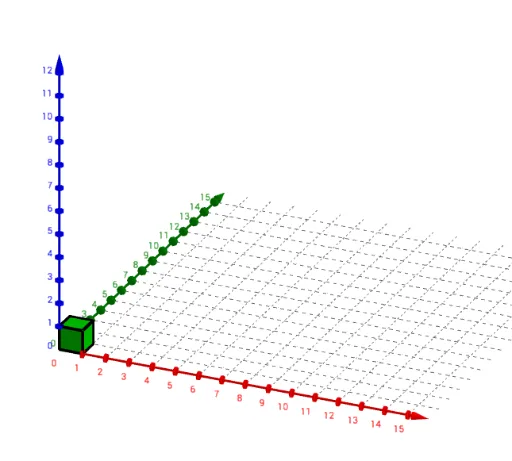
This GeoGebra example demonstrates the concept of cube roots through a three-dimensional cube and associated geometric constructions. It integrates core mathematical ideas such as cube roots, cubes, geometric construction, sequences, and summation concepts (e.g., Riemann sums), while also incorporating hyperbolas and isosceles triangles to bridge algebra and geometry. The construction uses GeoGebra commands including Intersect, Circle, Point, Cube, and Sequence, creating multiple points (A1-A10, B1-B10) and cube faces (faceABCD, faceADHE, etc.) and edges (edgeAD, edgeAB). These elements likely illustrate how cube roots vary with parameters. This resource is suitable for high school or early college students to explore the geometric meaning of cube roots, and can serve as a dynamic tool for inquiry-based learning, deepening understanding of radicals and their geometric representations.
GeoGebra Commands & Parameters
Intersect(xAxis, yAxis) → ACircle(A, cbrt(n)) → cIntersect(c, xAxis, 2) → BPoint(Circle[B, Distance[A, B], Segment[A, B]]) → CCube(A, B, C) → a, D, faceCDHG, faceEFGH, edgeAD, edgeAB, edgeBC, edgeCD, edgeAE, edgeDH, edgeEH, edgeEF, E, edgeBF, edgeFG, edgeCG, edgeGH, F, G, H, faceABCD, faceADHE, faceABFE, faceBCGFSequence(Segment[A + (i * (0, 0, 1)), B + (i * (0, 0, 1))], i, 1, edgeAB) → list1Sequence(Segment[A + (i * (0, 1, 0)), E + (i * (0, 1, 0))], i, 1, edgeAB) → list2Sequence(Segment[A + (i * (1, 0, 0)), E + (i * (1, 0, 0))], i, 1, edgeAB) → list3Sequence(Segment[A + (i * (0, 1, 0)), B + (i * (0, 1, 0))], i, 1, edgeAB) → list4Sequence(Segment[A + (i * (1, 0, 0)), D + (i * (1, 0, 0))], i, 1, edgeAB) → list5Sequence(Segment[A + (i * (0, 0, 1)), D + (i * (0, 0, 1))], i, 1, edgeAB) → list6Sequence(Segment[D + (i * (0, 0, 1)), C + (i * (0, 0, 1))], i, 1, edgeAB) → list7Sequence(Segment[D + (i * (1, 0, 0)), H + (i * (1, 0, 0))], i, 1, edgeAB) → list8Sequence(Segment[B + (i * (0, 0, 1)), C + (i * (0, 0, 1))], i, 1, edgeAB) → list9Sequence(Segment[B + (i * (0, 1, 0)), F + (i * (0, 1, 0))], i, 1, edgeAB) → list10Sequence(Segment[E + (i * (0, 1, 0)), F + (i * (0, 1, 0))], i, 1, edgeAB) → list11Sequence(Segment[E + (i * (1, 0, 0)), H + (i * (1, 0, 0))], i, 1, edgeAB) → list12