
Sine Values and Nested Triangles
Loading the math board and drawing, please wait…
In collections
Trigonometry: Basic and More
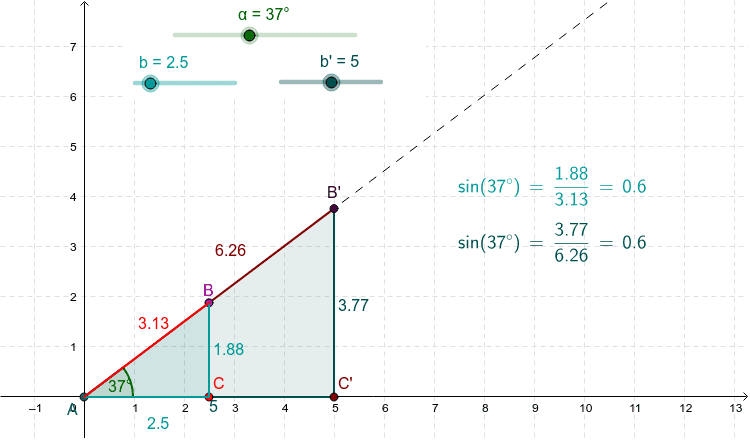
This example demonstrates the well-defined nature of the sine function using nested (similar) triangles. It involves core math concepts like right triangles, sine function, similar triangles, and angles. Construction highlights include using GeoGebra commands such as Point, Intersect, Rotate, Angle, Ray, OrthogonalLine, and Polygon. Suitable for high school mathematics education to visually explain the definition and properties of the sine function.
GeoGebra Commands & Parameters
Point(xAxis) → ZIntersect(xAxis, yAxis) → ARotate(Z, α, A) → Z'Angle(Z, A, Z') → βRay(A, Z') → zOrthogonalLine(C, xAxis) → b_3Intersect(b_3, z) → BOrthogonalLine(C', xAxis) → a'_1Intersect(a'_1, z) → B'Polygon(A, C, B) → poly1, b_1, a, cPolygon(A, C', B') → poly2, b'_1, a', c'
AI Drawing Prompt Reference
Draw a right triangle with one acute angle α, with the right angle vertex on the x-axis. From the acute angle vertex, draw a ray along the x-axis. At the acute angle vertex, construct an angle of β with the ray, and draw a ray from the vertex of this angle. Draw two perpendicular lines on the x-axis, intersecting the ray at two points. Connect these two points to the right angle vertex of the triangle, forming two similar triangles.
The prompt above was compiled from the original drawing commands and is for reference only.