
Perimeter of Open PolyLine 4
Loading the math board and drawing, please wait…
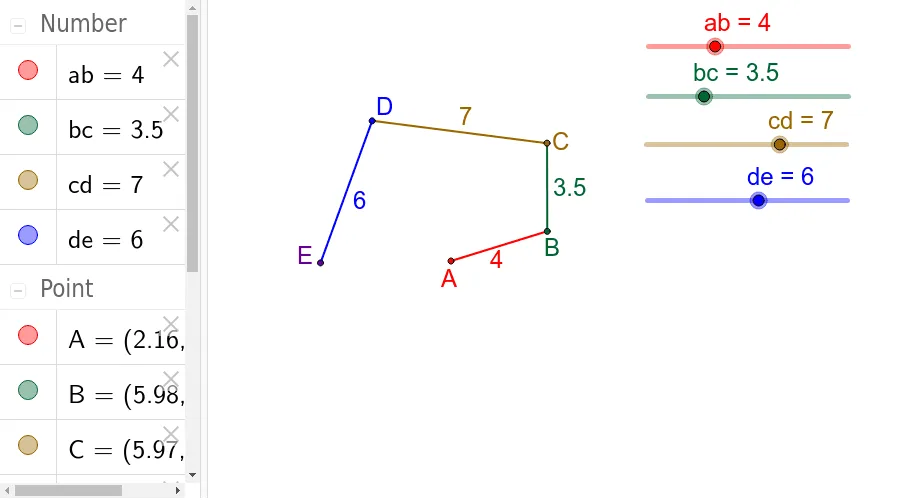
① This example demonstrates an open polyline composed of several connected segments, where dragging point A moves the entire polyline while its total length (perimeter) is dynamically calculated. ② The core mathematical concepts include perimeter of a polyline, sum of segment lengths, distance formula in coordinate geometry, and the effect of rigid motion on geometric measurements. ③ Construction details: using GeoGebra commands Point to create points A, B, C, D, E, and Segment to construct segments ab, bc, cd, de forming the open polyline; moving point A translates the whole figure without changing segment lengths, highlighting the invariance of perimeter under translation. ④ Suitable for middle school to high school students learning geometric measurement, dynamic geometry, or as a classroom demonstration for exploring how transformations affect lengths.
GeoGebra Commands & Parameters
Point(Circle[A, ab]) → BPoint(Circle[B, bc]) → CPoint(Circle[C, cd]) → DSegment(A, B) → aSegment(B, C) → bSegment(C, D) → cPoint(Circle[D, de]) → ESegment(D, E) → d
AI Drawing Prompt Reference
Draw an open polyline consisting of four connected segments with five vertices. Starting from the initial point, connect four points in sequence to form an unclosed path. Each subsequent vertex lies on a circle centered at the current endpoint with a radius equal to the specified segment length, ensuring fixed segment lengths. The entire polyline can be translated as a whole; dragging the starting point moves all vertices together while segment lengths remain unchanged, and the total perimeter (sum of segment lengths) stays constant. Clearly display all vertices and segments, and label the total length value to demonstrate that translation does not alter the perimeter.
The prompt above was compiled from the original drawing commands and is for reference only.