
Sine Rule (with proof) - Dynamic Geometry Demonstration
Loading the math board and drawing, please wait…
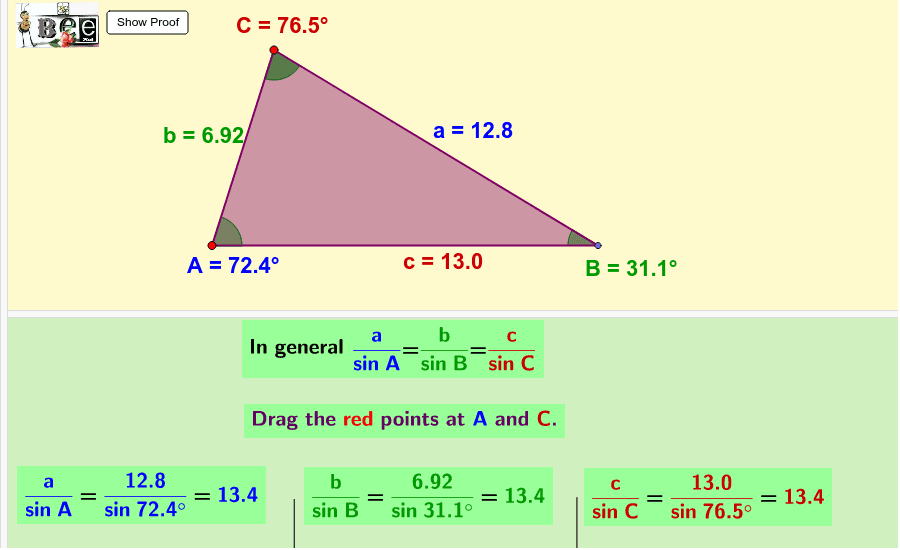
① This GeoGebra example dynamically demonstrates the sine rule (a/sin A = b/sin B = c/sin C = 2R) in a triangle, complete with a step-by-step proof presented through interactive text. ② Core mathematical concepts include the sine rule, relationships between sides and angles in a triangle, the circumradius, and geometric proof techniques using auxiliary constructions. ③ Construction highlights: using GeoGebra commands such as Point, Polygon, OrthogonalLine, Intersect, Segment, Angle, and Midpoint to build the triangle, altitudes, and circumcircle-related elements; objects include vertices A, B, C, sides a, b, c, altitudes d, e, angles α, β, γ, and multiple text objects (text1 to text20) that display proof steps and formulas; a button (button1) controls animation or step navigation. ④ Suitable for high school students learning trigonometry and triangle solving, and useful for teachers demonstrating the sine rule's geometric meaning and proof in class or for students' self-exploration.
GeoGebra Commands & Parameters
Point(xAxis) → APoint(xAxis) → BPolygon(A, B, C) → poly1, c, a, bOrthogonalLine(C, c) → dIntersect(d, xAxis) → DSegment(C, D) → eAngle(B, A, C) → αAngle(C, B, A) → βAngle(A, C, B) → γSegment(D, A) → fMidpoint(a) → EMidpoint(c) → FMidpoint(b) → GAngle(A, D, C) → δMidpoint(e) → HMidpoint(f) → IMidpoint(D, B) → JSegment(K, L) → lSegment(O, P) → m
AI Drawing Prompt Reference
Place two points on the x-axis as the base vertices of a triangle, and add a third point to form a triangle. Drop a perpendicular from the third vertex to the base, meeting the x-axis at a foot, and connect the foot to the third vertex to create the altitude. Label the three interior angles of the triangle, and also label the angle at the foot with the base vertex. Mark the midpoints of all three sides, as well as the midpoints of the altitude and the segment from the foot to one base vertex. Finally, draw two additional segments connecting arbitrary points to illustrate auxiliary constructions. The overall figure demonstrates the geometric proof of the sine rule, showing the triangle, altitude, midpoints, and auxiliary lines.
The prompt above was compiled from the original drawing commands and is for reference only.