
Sine Rule Ambiguous Case
Loading the math board and drawing, please wait…
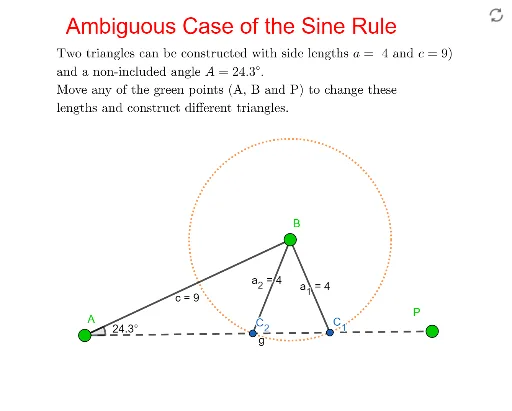
This example demonstrates the ambiguous case of the sine rule in triangle construction, where given two angles and one side (AaC), there might be two distinct triangle solutions. It involves core math concepts like the sine rule, triangle similarity, and the relationship between angles and sides. Constructed using GeoGebra commands such as Segment, Point, Circle, Intersect, Distance, Circumference, PointIn, and Angle. Suitable for high school mathematics teaching to understand special cases in applying the sine rule.
GeoGebra Commands & Parameters
Segment(A, B) → cSegment(A, P) → gPoint(g) → C_2Segment(B, C_2) → a_2Circle(B, C_2) → c_1Intersect(c_1, g, 2) → C_1Segment(B, C_1) → a_1Distance(B, C_2) → distanceBDDistance(B, C_1) → distanceBFCircumference(c_1) → circumferencecPointIn(c_1) → Pointc_1Circumference(c_1) → a_3PointIn(c_1) → PointcAngle(P, A, B) → α
AI Drawing Prompt Reference
Draw a triangle demonstrating the ambiguous case of the sine rule, where given two angles and one side, there might be two distinct solutions. Start by drawing a side and one angle, then draw a circle with the opposite side as the radius intersecting the line containing the angle to find two possible vertices. Connect the vertices to the center of the circle, label key lengths and angles, and display the two possible triangle solutions.
The prompt above was compiled from the original drawing commands and is for reference only.