
Sine, Cosine and Tangent in a Unit Circle
Loading the math board and drawing, please wait…
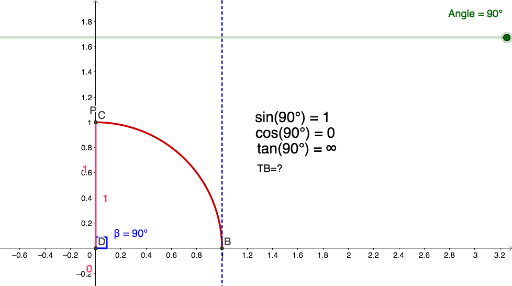
This example demonstrates how sine, cosine, and tangent are defined in a unit circle. It involves key concepts of trigonometry, using GeoGebra commands such as rotation, angle, and tangent to dynamically illustrate the geometric meanings of these functions. Suitable for students at the junior high school level and above.
GeoGebra Commands & Parameters
Intersect(xAxis, yAxis) → ATextfield() → InputBox1Intersect(g, xAxis, (1, 0)) → BIntersect(g, yAxis, (0, 1)) → CRotate(B, Angle, A) → PAngle(B, A, P) → βOrthogonalLine(P, xAxis) → aIntersect(a, xAxis) → DPolygon(A, P, D) → poly1, d, a_1, b'Angle(P, D, A) → γTangent(B, g) → bTangent(B, g) → cOrthogonalLine(B, xAxis) → eIntersect(h, e, 1) → TAngle(T, B, A) → δDistance(T, B) → distanceTBSegment(B, T) → TB
AI Drawing Prompt Reference
Draw a unit circle and mark a point B on it. Rotate point B around point A to get point P. Draw a perpendicular line from P to the x-axis, intersecting at point D. Connect points A, P, and D to form a triangle, label angles β, γ, and δ. Draw a tangent line at point B and mark its intersection with the x-axis as point T. Measure the length of segment TB.
The prompt above was compiled from the original drawing commands and is for reference only.