
Sin(x) and Cos(x) from the Unit Circle (3D)
Loading the math board and drawing, please wait…
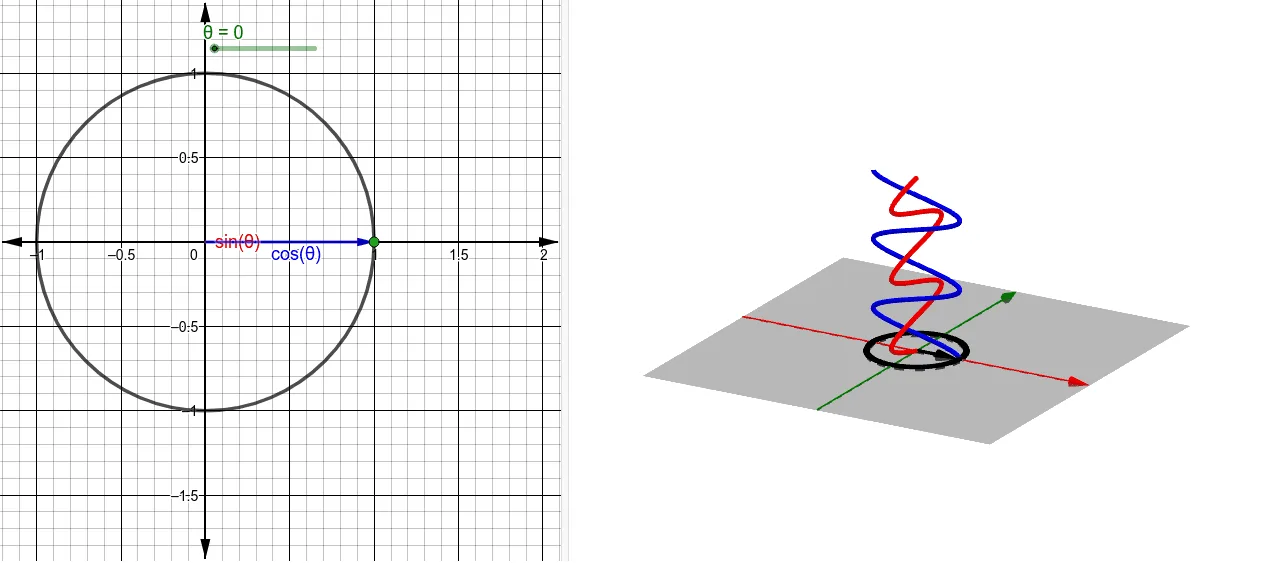
This example demonstrates the sine and cosine functions from the unit circle in a 3D view. ① It illustrates how the sine and cosine values are defined by the projections of a point P on the unit circle onto the x-axis and y-axis. ② The core mathematical concepts involved include angles, the unit circle, sine function, cosine function, trigonometric functions, and coordinate geometry. ③ The construction uses GeoGebra commands such as Circle, Vector, Segment, CurveCartesian, and Angle, along with objects like UC (unit circle), θ (angle), r (radius), vseg (vertical segment), hseg (horizontal segment), sincurve (sine curve), coscurve (cosine curve), sinvec (sine vector), cosvec (cosine vector), ang (angle), and P. ④ It is suitable for high school mathematics students to learn and understand the relationship between trigonometric functions and the unit circle, and can also be used in calculus and coordinate geometry teaching.
GeoGebra Commands & Parameters
Circle((0, 0), 1) → UCVector((0, 0), (cos(θ), sin(θ))) → rSegment((cos(θ), 0), (cos(θ), sin(θ))) → vsegSegment((0, sin(θ)), (cos(θ), sin(θ))) → hsegCurveCartesian(0, sin(θ - t), t, t, 0, (5 * π)) → sincurveCurveCartesian(cos(θ - t), 0, t, t, 0, (5 * π)) → coscurveVector((0, 0), (0, sin(θ))) → sinvecVector((0, 0), (cos(θ), 0)) → cosvecAngle(r) → ang