
Simultaneous Equations as Sum of 3 Vectors
Loading the math board and drawing, please wait…
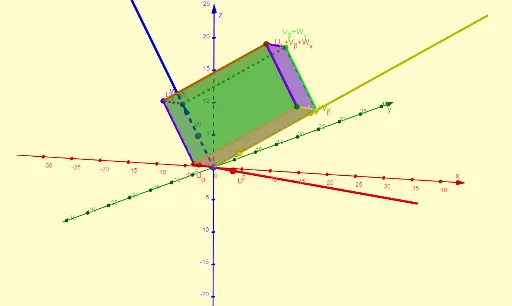
This example demonstrates how a system of three simultaneous linear equations can be visualized as the sum of three vectors. Key math concepts include vectors, systems of linear equations, and linear combinations. GeoGebra commands used are Ray and Polygon, with objects like O (origin), U (vector), h (length), α (angle), αU (rotated vector), U_α (rotated vector), V (vector), i (unit vector), β (angle), βV (rotated vector), V_β (rotated vector), W (vector), j (unit vector), γ (angle), γW (rotated vector), W_γ (rotated vector), and points A, B, C, D, along with variables q1, a_4, a_1, a_3, a_2, q2, b_4, b_1, b_2, b_3, q3, c_4, c_2, c_1, c_3, q4, d_1, d_4, d_2, d_3. Suitable for high school and above students studying vector applications and linear algebra.
GeoGebra Commands & Parameters
Ray(O, U) → hRay(O, V) → iRay(O, W) → jPolygon(U_α, A, C, B) → q1, a_4, a_1, a_3, a_2Polygon(W_γ, B, C, D) → q2, b_4, b_1, b_2, b_3Polygon(V_β, D, C, A) → q3, c_4, c_2, c_1, c_3Polygon(O, W_γ, D, V_β) → q4, d_1, d_4, d_2, d_3Polygon(O, U_α, A, V_β) → q5, e_2, e_3, e_1, e_4Polygon(O, U_α, B, W_γ) → q6, f_2, f_3, f_1, f_4
AI Drawing Prompt Reference
Draw three vectors U, V, and W in a 3D vector space, and their rotated vectors U_α, V_β, and W_γ. Construct four quadrilaterals using these vectors and their rotated vectors to represent the solutions of a system of linear equations. First, draw vectors U, V, and W, then rotate them to get U_α, V_β, and W_γ. Finally, use these vectors and their rotated vectors to construct the quadrilaterals.
The prompt above was compiled from the original drawing commands and is for reference only.