
Simple Harmonic Motion - SHM
Loading the math board and drawing, please wait…
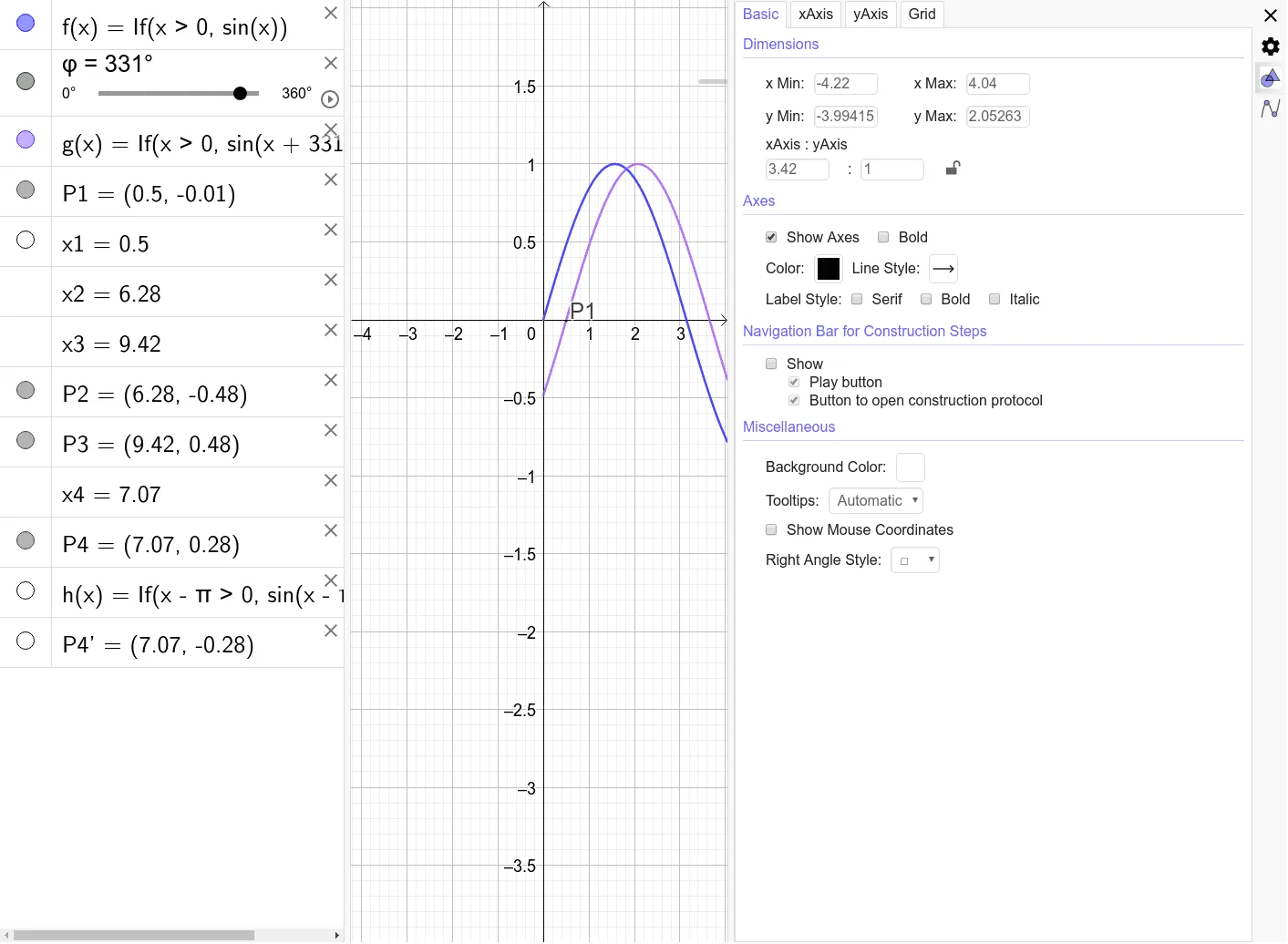
This example demonstrates the graphical representation of Simple Harmonic Motion (SHM). Core mathematical concepts include function graphs, trigonometric functions, geometric transformations, and coordinate systems. Construction highlights the use of GeoGebra commands/objects like f (function), φ (phase), g (gravity), P1, P2, P3, P4 (points), x1, x2, x3, x4 (coordinates), and h (height). Suitable for high school physics and mathematics education to understand the principles and graphical characteristics of SHM.
GeoGebra Commands & Parameters
f(x) = If[x > 0, sin(x)]Angle φ(5.777039824101231)g(x) = If[x > 0, sin(x + φ)](0.5, g(0.5))0.5(2 * π)(3 * π)(x2, g(x2))(x3, g(x3))(2 * π) + π / 4(x4, g(x4))h(x) = g(x - π)(x4, h(x4))
AI Drawing Prompt Reference
Draw the graph of simple harmonic motion by first plotting the sine function f(x) = sin(x), then add the phase angle φ=5.777, and plot the phase-shifted function g(x) = sin(x + φ). Mark point P1 at x=0.5 with its y-value 0.5, then draw 2π and 3π, and mark points P2 and P3. Next, mark point P4 at x=2π+π/4, and finally plot the function h(x) = g(x - π) and mark the corresponding point at P4.
The prompt above was compiled from the original drawing commands and is for reference only.