
Simple Harmonic Motion of a Horizontal Spring
Loading the math board and drawing, please wait…
In collections
El dominio del Tiempo (cinemática intuitiva)
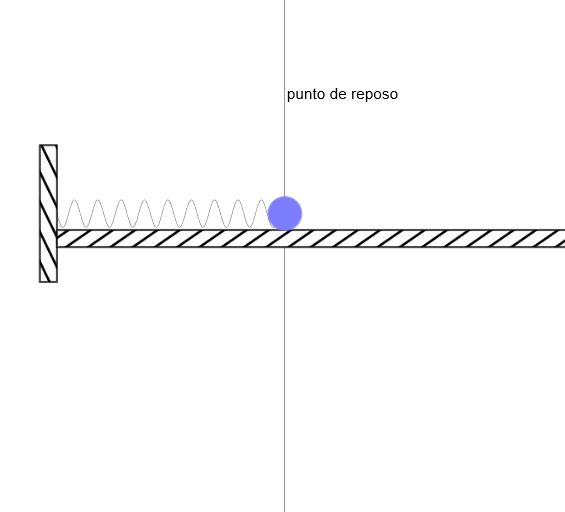
This example demonstrates the simple harmonic motion of a horizontal spring. Key mathematical concepts include spring force, resonance frequency, and displacement over time. Construction involves using GeoGebra commands such as Point, If, Segment, and Circle to build the spring model, mark critical points, and analyze the trajectory. Suitable for high school or university physics and mathematics courses to understand basic vibration principles and geometric construction techniques.
GeoGebra Commands & Parameters
Point(Segment[O, (2 * O) - P]) → QIf(Length[reg] ≟ 1, {reg(1)}, Sequence[reg(k) - reg(k + 1), k, 1, Length[reg] - 1]) → regDifmean(regDif) → TSegment((x(Q), y(B) + 0.1), (x(O), y(B) + 0.1)) → jCircle(M, r) → cirCurveCartesian(t, (1.2 * sin(((20 * pi) * (t - (x(M) + 0.5)) / (x(P0) - (x(M) + 0.5))))), t, x(P0), x(M)) → muelle
AI Drawing Prompt Reference
Draw a simple harmonic motion model of a horizontal spring. On the left side of the canvas there is a fixed point O, and on the right side there is a movable point P, connected by a horizontal spring represented as a periodic wavy line to show its stretching and compression. Take the center point M of the spring at rest position as the center to draw a circle, with a moving particle on the circle. Also plot a sine curve showing how the particle's displacement varies with time, reflecting the periodic nature of simple harmonic motion. The entire model illustrates the relationship between displacement, velocity, and acceleration of a spring oscillator at different positions.
The prompt above was compiled from the original drawing commands and is for reference only.