
Simple 3D Problems 1
Loading the math board and drawing, please wait…
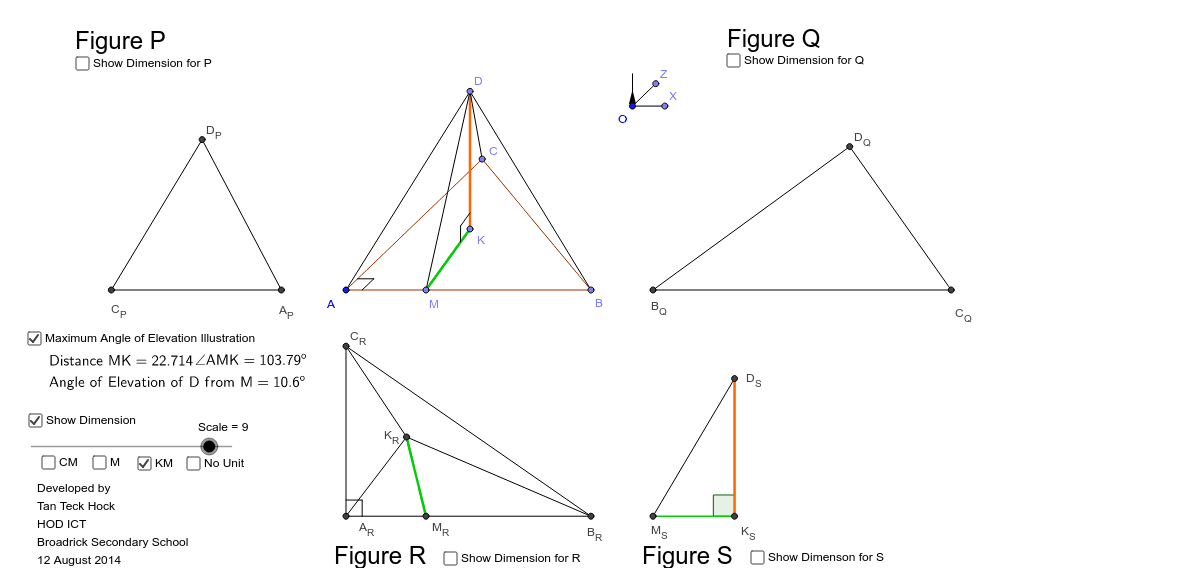
This example demonstrates the geometric construction and property analysis of a pyramid in three-dimensional space. It involves core mathematical concepts such as trigonometry, angle calculations, optimization problems, centroid or barycenter, and solid geometry. The construction highlights the use of GeoGebra commands and objects like Circle, Point, Segment, Line, Angle, Polygon, PointIn, Intersect, OrthogonalLine, Vector, Translate, and Midpoint. Suitable for high school and above students learning applications of solid geometry, vectors, and optimization problems.
GeoGebra Commands & Parameters
Circle(O, Radius) → axiscirclePoint(axiscircle) → YSegment(O, Y) → OXPoint(axiscircle) → ZSegment(O, Z) → OZLine(A, OZ) → yaxisPoint(yaxis) → edgeYPtSegment(A, edgeYPt) → edgeYPoint(axiscircle) → XAngle(X, O, Z) → αSegment(O, X) → OYLine(A, OY) → CParallelCBPoint(CParallelCB) → edgeXPtPolygon(edgeYPt, A, edgeXPt) → MaxBase, MaxBaseEdge2, MaxBaseEdge1, MaxBaseEdge3PointIn(MaxBase) → CLine(A, C) → MaxBaseDividerIntersect(MaxBaseEdge3, MaxBaseDivider) → MaxBaseDividerPtPolygon(MaxBaseDividerPt, A, edgeXPt) → MaxBaseLowerHalf, MaxBaseLowerHalfEdge2, MaxBaseLowerHalfEdge1, MaxBaseLowerHalfEdge3PointIn(MaxBaseLowerHalf) → BPolygon(A, B, C) → Base, AB, BC, ACPointIn(Base) → KLine(K, OX) → VerticalFromBasePoint(VerticalFromBase) → VerticalFromBasePtSegment(K, VerticalFromBasePt) → MaxHeightPoint(MaxHeight) → DLine(K, OZ) → KParallelZLine(K, OY) → KParallelXIntersect(KParallelX, edgeY) → K_ZLine(C, OY) → CParallelXIntersect(CParallelX, edgeY) → C_ZLine(C, OZ) → CParallelZSegment(A, edgeXPt) → edgeXIntersect(KParallelZ, edgeX) → K_XCircle(A_P, LengthDA / Scale) → CircleAtA_PIntersect(CParallelZ, edgeX) → C_XCircle(C_P, LengthDC / Scale) → CircleAtC_PLine(B, OY) → BParallelXLine(B, OZ) → BParallelZIntersect(BParallelZ, edgeX) → B_XIntersect(BParallelX, edgeY) → B_ZCircle(C_Q, LengthDC / Scale) → CircleAtC_QCircle(B_Q, LengthDB / Scale) → CircleAtB_QOrthogonalLine(K, AC) → KPerpendicularACIntersect(KPerpendicularAC, AC) → KonACPoint(AB) → MLine(M, OY) → MParallelXLine(M, OZ) → MParallelZIntersect(MParallelZ, edgeX) → M_XIntersect(MParallelX, edgeY) → M_ZPoint(OX) → RightAngleDistanceVector(O, RightAngleDistance) → uTranslate(K, u) → DKA3Line(A, OX) → zaxisPoint(zaxis) → edgeZPtSegment(A, edgeZPt) → edgeZSegment(K, D) → KDSegment(A, D) → DASegment(D, C) → DCSegment(D, B) → DBSegment(B_Q, C_Q) → BC_QIntersect(CircleAtB_Q, CircleAtC_Q) → D_Q, D_{Q'}, ,Segment(C_Q, D_Q) → DC_QSegment(D_Q, B_Q) → DB_QSegment(D_S, M_S) → DM_SSegment(D_S, K_S) → DK_SSegment(C_R, A_R) → AC_RSegment(A_R, B_R) → AB_RSegment(B_R, C_R) → BC_RSegment(K_R, A_R) → KA_RSegment(K_R, B_R) → KB_RSegment(K_R, C_R) → KC_RSegment(K, M) → MKSegment(D, M) → DMSegment(K_R, M_R) → KM_RCircle(K, KVertical) → CircleAtKIntersect(CircleAtK, MK) → KHorizontal1,Line(KHorizontal1, KD) → KPerpendicularMKLine(KVertical, MK) → KParallelMKIntersect(KParallelMK, KPerpendicularMK) → KAngle1Segment(KHorizontal1, KAngle1) → KAngleVertical1Segment(KAngle1, KVertical) → KAngleHorizontal1Line(KVertical, AC) → KParallelACIntersect(CircleAtK, AC) → KHorizontal2, KHorizontal3Line(KHorizontal3, KD) → KParallelDK2Line(KHorizontal2, KD) → KParallelDK1Intersect(KParallelDK2, KParallelAC) → KAngle3Intersect(KParallelDK1, KParallelAC) → KAngle2Segment(KHorizontal3, KAngle3) → KAngleVertical3Segment(KAngle3, KVertical) → KAngleHorizontal3Segment(KVertical, KAngle2) → KAngleHorizontal2Segment(KAngle2, KHorizontal2) → KAngleVertical2Intersect(CircleAtK, BC) → KHorizontal4, KHorizontal5Line(KHorizontal4, KD) → KParallelDK3Line(KHorizontal5, KD) → KParallelDK4Line(KVertical, BC) → KParallelBCIntersect(KParallelDK3, KParallelBC) → KAngle4Intersect(KParallelDK4, KParallelBC) → KAngle5Segment(KVertical, KAngle4) → KAngleHorizontal4Segment(KHorizontal4, KAngle4) → KAngleVertical4Segment(KVertical, KAngle5) → KAngleHorizontal5Segment(KAngle5, KHorizontal5) → KAngleVertical5Segment(A_{R2}, A_{R3}) → A_RAngleHorizontalSegment(A_{R1}, A_{R3}) → A_RAngleVerticalSegment(B_{R3}, B_{R2}) → B_RAngleHorizontalSegment(B_{R1}, B_{R2}) → B_RAngleVerticalCircle(B, BAnglePoint1) → CircleAtBIntersect(CircleAtB, BC) → BAnglePoint2,Line(BAnglePoint2, edgeX) → BParallelX1Line(BAnglePoint1, BC) → BParallelZ1Intersect(BParallelZ1, BParallelX1) → BAnglePoint3Segment(BAnglePoint1, BAnglePoint3) → BAngleLine1Segment(BAnglePoint3, BAnglePoint2) → BAngleLine2Circle(C, 0.5) → CircleAtCIntersect(CircleAtC, AC) → CAnglePoint2,Line(CAnglePoint2, BC) → CParallelBCCircle(C_R, 0.5) → CircleAtC_TIntersect(CircleAtC_T, AC_R) → C_{R1},Intersect(CircleAtC_T, BC_R, 1) → C_{R2}Line(C_{R1}, BC_R) → C_TParallelBCLine(C_{R2}, AC_R) → C_TParallelACIntersect(C_TParallelBC, C_TParallelAC) → C_{R3}Segment(C_{R3}, C_{R1}) → C_RAngle1Segment(C_{R3}, C_{R2}) → C_RAngle2Intersect(CircleAtC, BC) → CAnglePoint1,Line(CAnglePoint1, AC) → CParallelACIntersect(CParallelAC, CParallelBC) → CAnglePoint3Segment(CAnglePoint2, CAnglePoint3) → CAngleLine1Segment(CAnglePoint3, CAnglePoint1) → CAngleLine2Circle(A, 0.5) → CircleAtAIntersect(CircleAtA, AC) → AAnglePoint1,Intersect(CircleAtA, AB) → AAnglePoint2,Line(AAnglePoint1, AB) → AParallelABLine(AAnglePoint2, AC) → AParallelACIntersect(AParallelAC, AParallelAB) → AAnglePoint3Segment(AAnglePoint2, AAnglePoint3) → AAngleLine1Segment(AAnglePoint3, AAnglePoint1) → AAngleLine2Circle(M_R, 0.5) → CircleAtM_TIntersect(CircleAtM_T, AB_R) → M_RAnglePoint1, M_RAnglePoint2Intersect(CircleAtM_T, KM_R) → M_RAnglePoint3,Line(M_RAnglePoint1, KM_R) → M_TParallelMK2Line(M_RAnglePoint3, AB_R) → M_TParallelABLine(M_RAnglePoint2, KM_R) → M_TParallelMK1Intersect(M_TParallelMK2, M_TParallelAB) → M_RAnglePoint4Intersect(M_TParallelMK1, M_TParallelAB) → M_RAnglePoint5Segment(M_RAnglePoint2, M_RAnglePoint5) → M_RAngleLine1Segment(M_RAnglePoint5, M_RAnglePoint3) → M_RAngleLine2Segment(M_RAnglePoint1, M_RAnglePoint4) → M_RAngleLine3Segment(M_RAnglePoint4, M_RAnglePoint3) → M_RAngleLine4Intersect(CircleAtC_P, CircleAtA_P) → D_P, D_{P'}, ,Segment(D_P, A_P) → DA_PSegment(D_P, C_P) → DC_PSegment(A_P, C_P) → AC_PMidpoint(A, C) → MidPointACMidpoint(A_R, C_R) → MidPointAC_RMidpoint(A, B) → MidPointABMidpoint(A_R, B_R) → MidPointAB_RMidpoint(B, C) → MidPointBCMidpoint(B_R, C_R) → MidPointBC_RMidpoint(D_Q, C_Q) → MidPointDC_QMidpoint(D, C) → MidPointDCMidpoint(D, B) → MidPointDBSegment(M_S, K_S) → MK_SMidpoint(B_Q, C_Q) → MidPointBC_QMidpoint(B_Q, D_Q) → MidPointDB_QMidpoint(M, K) → MidPointMKMidpoint(D, K) → MidPointDKMidpoint(M, D) → MidPointDMMidpoint(M_S, K_S) → MidPointMK_SMidpoint(D_S, M_S) → MidPointDM_SMidpoint(D_S, K_S) → MidPointDK_SMidpoint(A, D) → MidPointDAMidpoint(A_P, C_P) → MidPointAC_PMidpoint(D_P, A_P) → MidPointAD_PMidpoint(D_P, C_P) → MidPointCD_PAngle(D_S, K_S, M_S) → DKM_SAngle(D_P, A_P, C_P) → DAC_PAngle(A_P, C_P, D_P) → DCA_PAngle(D_Q, C_Q, B_Q) → DCB_QAngle(C_Q, B_Q, D_Q) → DBC_Q
AI Drawing Prompt Reference
Draw a pyramid in 3D space by first creating a circle and marking points on it. Connect the center to these points to form edges, and calculate angles. Then, connect different points to create the base of the pyramid and find its centroid. Next, draw perpendicular lines from the centroid to one side of the base to determine the height of the pyramid. Finally, draw circles at the vertices of the pyramid and connect corresponding points to form the sides, completing the pyramid.
The prompt above was compiled from the original drawing commands and is for reference only.