
Similarity with Billiard: Dynamic Geometry Exploration
Loading the math board and drawing, please wait…
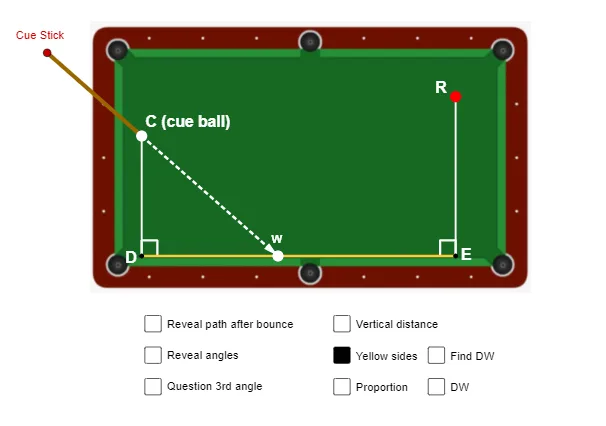
① This example simulates billiard ball reflections on a triangular table, demonstrating the connection between similarity transformations and special points such as the orthocenter. ② Core mathematical concepts include similarity transformation, orthocenter, special points, polygons, random experiments, angles, vectors, and reflections. ③ Construction uses GeoGebra commands: Segment, Rotate, Point, Line, Intersect, Mirror, Ray, Angle, and Vector, creating the triangle, reflection paths, orthocenter, and auxiliary lines, with random variables for stochastic simulation. ④ Suitable for high school or college geometry courses, ideal for exploring similarity in dynamic contexts and for inquiry-based learning or mathematical experimentation.
GeoGebra Commands & Parameters
Segment(C_{1}, D) → fRotate(D, 33°, C_{1}) → D'Segment(D, C) → gPoint(f) → GPoint(f) → HSegment(C_{1}, R) → jLine(C_{1}, R) → kPoint(Circle[C, 4]) → FLine(F, C) → hIntersect(h, f) → WSegment(F, W) → iPoint(i) → JPoint(i) → KSegment(F, C) → lMirror(C, eq1) → C'Ray(W, C') → mIntersect(m, eq2) → LSegment(W, L) → nSegment(D, W) → pSegment(W, C_{1}) → qAngle(F, W, D) → αAngle(C_{1}, W, L) → βSegment(L, R) → rAngle(W, D, C) → γAngle(I, C_{1}, W) → δVector(C, W) → u
AI Drawing Prompt Reference
Construct a triangular table using three points and draw a dynamic billiard-style reflection path. Start by taking a segment on a reference side, rotate it around a triangle vertex by a fixed angle to get a new point, then draw connecting lines and form their intersection points. Use symmetry/mirroring about a chosen axis to define reflected points, and from one intersection point draw a ray that intersects another line to determine reflection endpoints. Include a circle centered at one triangle point with a given radius, place a point on the circle, and connect it to another triangle vertex to form key segments. Add several angle measures at the main intersection points and optionally draw a vector to represent the direction relationship related to similarity.
The prompt above was compiled from the original drawing commands and is for reference only.