
Similar Triangles Construction and Properties
Loading the math board and drawing, please wait…
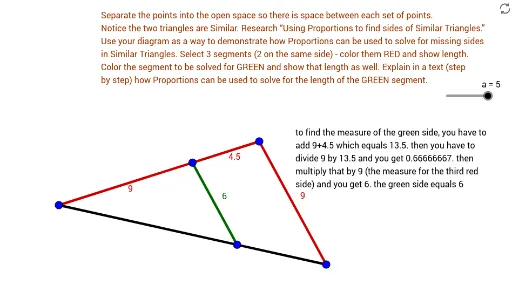
① This GeoGebra example dynamically demonstrates the construction of similar triangles, visually showing that corresponding angles are equal and corresponding sides are proportional. ② Core mathematical concepts include the criteria for triangle similarity, proportional relationships, and the preservation of shape under transformations such as dilation, reflection, and rotation. ③ Construction highlights: from the summary, commands such as Mirror, Ray, Point, Line, Intersect, Polygon, Segment, Dilate, OrthogonalLine, Angle, and Distance are used to create multiple triangles (poly1, poly2, poly3) and auxiliary lines, generating similar figures through scaling and mirroring. ④ Suitable for middle school or early high school students learning about similar triangles, as well as for teaching geometric construction with dynamic software.
GeoGebra Commands & Parameters
Mirror(G, F) → G'Ray(F, G') → lPoint(l) → JLine(H, F) → q_2Line(G, H) → l_2Line(J, l_2) → p_2Intersect(q_2, p_2) → C_1Line(A, B) → b_1Polygon(C, A, B) → poly1, b, c, a_2Ray(A, C) → gPoint(g) → DLine(D, a_2) → h_2Intersect(h_2, b_1) → ZPolygon(F, G, H) → poly2, h_1, f_1, g_1Ray(A, B) → fSegment(D, A) → hSegment(E, A) → iSegment(D, E) → jMirror(H, F) → H'Ray(F, H') → kSegment(I, F) → mSegment(F, J) → nSegment(J, I) → pPolygon(A, D, E) → poly3, e, a_1, dPolygon(F, J, I) → poly4, i_1, f_2, j_1Polygon(K, L, M) → poly5, m_1, k_1, l_1Dilate(M, o, M) → M'Dilate(K, o, Scale) → K'Dilate(L, o, Scale) → L'Dilate(M, o, Scale) → M'_1Polygon(K', L', M'_1) → poly5', m'_1, k', l'Segment(O, P) → qSegment(O, Q) → rSegment(P, Q) → sDilate(O, 1 / 3, Q) → O'Line(O', s) → tIntersect(q, t) → RSegment(R, O') → n_1Segment(O, O') → p_1Segment(O', Q) → q_1Segment(R, P) → r_1Segment(R, O) → s_1Line(A, C) → t_1Line(F, p) → c_1Line(G, m) → d_1Intersect(d_1, c_1) → SLine(T, U) → e_1Point(e_1) → VOrthogonalLine(V, e_1) → g_2Point(g_2) → WSegment(W, U) → i_2Segment(U, V) → j_2Segment(W, V) → k_2OrthogonalLine(V, i_2) → m_2OrthogonalLine(V, j_2) → n_2Intersect(m_2, i_2) → A_1Segment(V, A_1) → r_2Intersect(i_2, r_2) → B_1Angle(V, U, W) → βAngle(U, W, V) → γAngle(W, A_1, V) → δAngle(U, A_1, V) → εAngle(W, V, A_1) → ζAngle(U, V, A_1) → ηDistance(W, i_2) → distanceWi2Distance(A_1, W) → distanceA1WDistance(A_1, U) → distanceA1ULine(G, F) → s_2