
Similar Triangles - Basic Construction and Properties
Loading the math board and drawing, please wait…
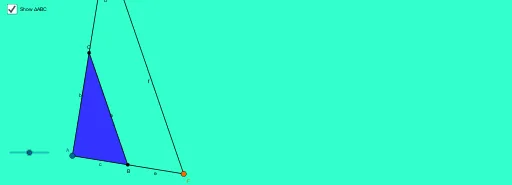
① This GeoGebra example demonstrates the construction of two similar triangles, showing that corresponding angles are equal and corresponding sides are proportional, thereby illustrating the fundamental properties of similar triangles. ② The core mathematical concepts involve the definition and criteria for triangle similarity, including equal corresponding angles and proportional corresponding sides, along with the similarity ratio, using basic geometric elements such as triangles, polygons, angles, and segments. ③ Construction highlights: Based on the construction summary, the example employs GeoGebra commands such as Ray, Rotate, Angle, Point, Segment, Polygon, Line, and Intersect, creating multiple points (A, B, C, D, E, F, etc.), segments (a, b, c, d, e, etc.), polygons (poly1, poly2), and angle objects (α, β). The similar triangles are formed through rotations and intersections of lines and rays. ④ This resource is suitable for middle school geometry teaching or self-study, helping learners understand the definition and criteria of similar triangles, observe similarity transformations dynamically, and serve as a template for teachers creating related courseware.
GeoGebra Commands & Parameters
Ray(A, F) → f_1Rotate(F, (a_3 * π / 180), A) → B'Angle(F, A, B') → αRay(A, B') → gPoint(g) → GSegment(G, F) → fSegment(A, F) → iPolygon(A, F, G) → poly1, c_1, a_1, b_1Segment(A, G) → jAngle(G, F, A) → βPoint(j) → DLine(D, f) → kIntersect(k, i) → ESegment(D, E) → aPolygon(A, E, D) → poly2, d_1, a_2, e_1Intersect(a, j) → CIntersect(i, xAxis) → G_1Intersect(a, i) → BSegment(A, C) → bSegment(C, G) → dSegment(A, B) → cSegment(B, F) → e
AI Drawing Prompt Reference
Draw two similar triangles. First, draw a ray from point A to F, then rotate point F to get point B', draw angle α, and draw a ray from A to B', find point G, connect points G and F, A and F, A and G, to form the first triangle. Next, draw angle β, find point D, draw a line from D to F, find point E, connect points D and E, D and A, A and E, to form the second triangle. Finally, connect points A and C, C and G, A and B, B and F, ensuring the two triangles are similar, with corresponding angles equal and corresponding sides proportional.
The prompt above was compiled from the original drawing commands and is for reference only.