
Similar Rectangles on the Sides of a Right Triangle
Loading the math board and drawing, please wait…
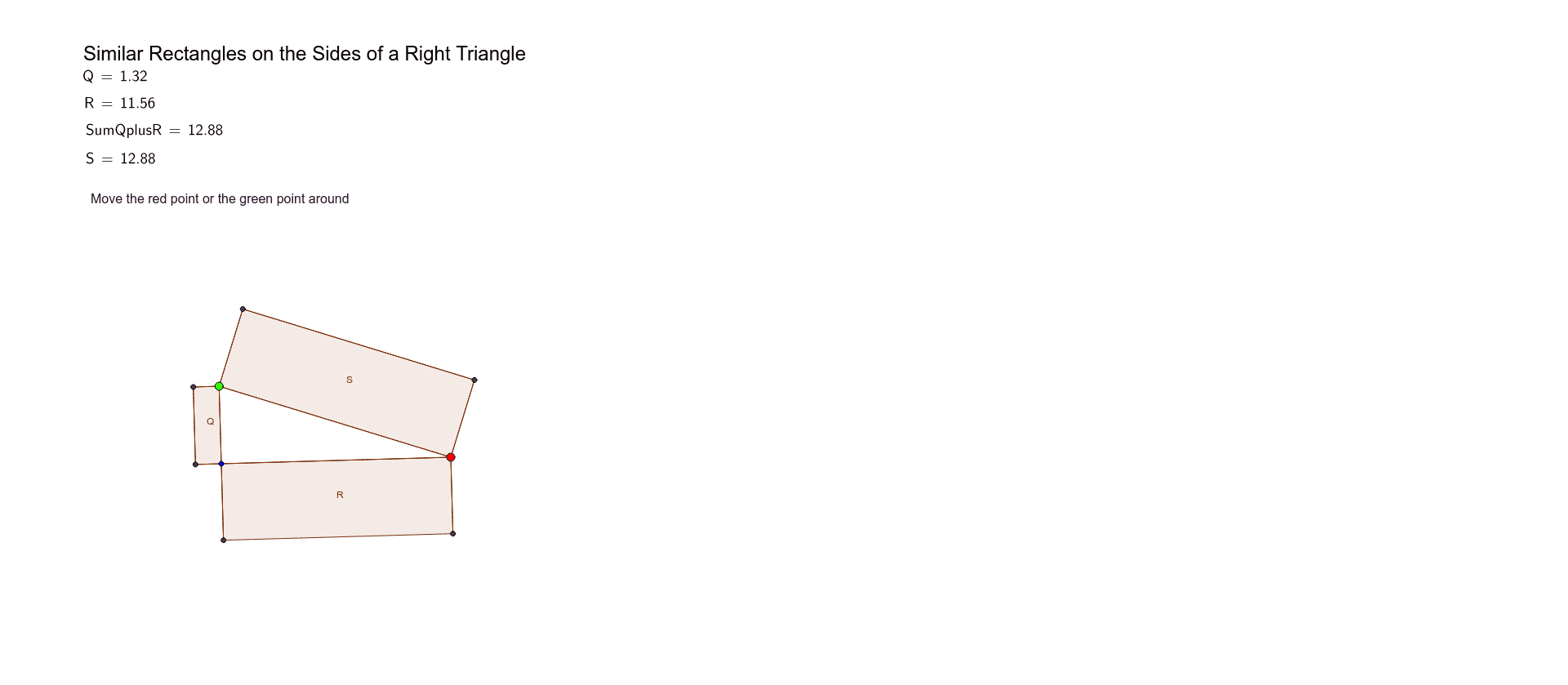
This example demonstrates constructing similar rectangles on the sides of a right triangle, revealing area relationships and connections to the Pythagorean theorem. Key math concepts include similar figures, Pythagorean theorem, area calculation, and proportional relationships. GeoGebra commands and objects used are segment, orthogonal line, point, circle, intersect, polygon, and LaTeX. Suitable for high school mathematics teaching to understand applications of similarity and the Pythagorean theorem.
GeoGebra Commands & Parameters
Segment(A, B) → aOrthogonalLine(A, a) → bPoint(b) → CSegment(C, A) → cSegment(C, B) → dCircle(C, d / 3) → eOrthogonalLine(C, d) → fIntersect(e, f) → D, ESegment(C, E) → gOrthogonalLine(E, g) → hOrthogonalLine(B, d) → iIntersect(i, h) → FSegment(E, F) → jSegment(B, F) → kCircle(C, c / 3) → pOrthogonalLine(C, c) → lIntersect(p, l) → G, HSegment(G, C) → mOrthogonalLine(G, m) → nOrthogonalLine(A, c) → qIntersect(n, q) → ISegment(G, I) → rSegment(I, A) → sOrthogonalLine(A, a) → tCircle(A, a / 3) → c_1Intersect(c_1, t) → J, KSegment(A, J) → a_1OrthogonalLine(J, a_1) → b_1OrthogonalLine(B, a) → d_1Intersect(b_1, d_1) → LSegment(B, L) → e_1Segment(L, J) → f_1Polygon(C, B, F, E) → S, c_2, b_2, f_2, e_2LaTeX(S, true, true) → text1Polygon(C, G, I, A) → Q, c_3, g_1, i_1, a_2LaTeX(Q, true, true) → text2Polygon(A, J, L, B) → R, a_3, j_1, l_1, b_3LaTeX(R, true, true) → text3LaTeX(SumQplusR, true, true) → text4