
Similar Rectangles (Pythagorean Cuts)
Loading the math board and drawing, please wait…
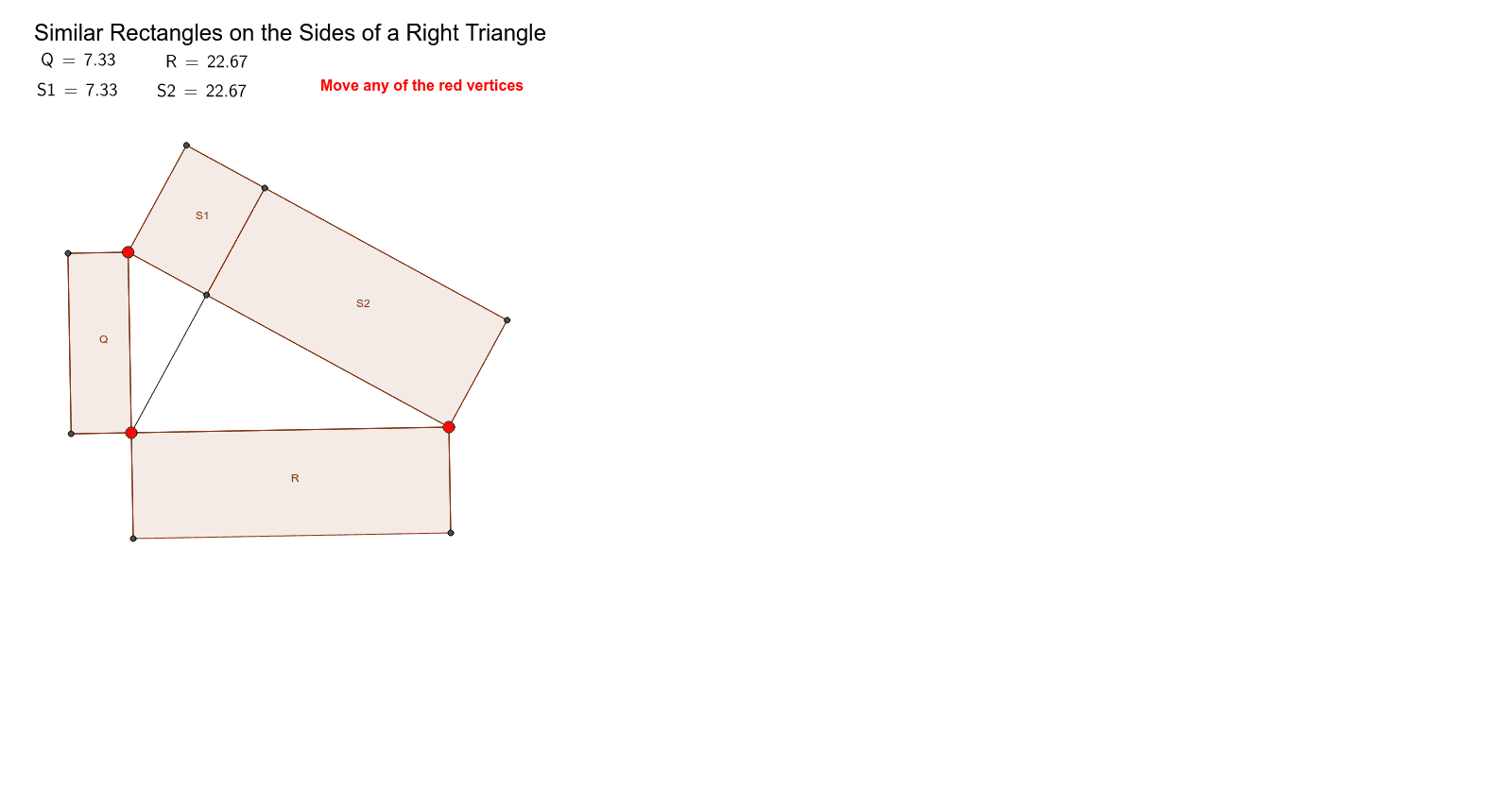
This example demonstrates the construction of similar rectangles using Pythagorean cuts. The core mathematical concepts involved include rectangles, coordinate geometry, reflection transformations, and sequences. Key points in the construction: Utilizes Segment, OrthogonalLine, Point, Circle, Intersect, Polygon, LaTeX, Line, and PointIn commands from GeoGebra. Suitable for high school mathematics courses to help students understand similar figures and applications of the Pythagorean theorem.
GeoGebra Commands & Parameters
Segment(A, B) → aOrthogonalLine(A, a) → bPoint(b) → CSegment(C, A) → cSegment(C, B) → dCircle(C, d / 3) → eOrthogonalLine(C, d) → fIntersect(e, f) → D, ESegment(C, E) → gOrthogonalLine(E, g) → hOrthogonalLine(B, d) → iIntersect(i, h) → FSegment(E, F) → jSegment(B, F) → kCircle(C, c / 3) → pOrthogonalLine(C, c) → lIntersect(p, l) → G, HSegment(G, C) → mOrthogonalLine(G, m) → nOrthogonalLine(A, c) → qIntersect(n, q) → ISegment(G, I) → rSegment(I, A) → sOrthogonalLine(A, a) → tCircle(A, a / 3) → c_1Intersect(c_1, t) → J, KSegment(A, J) → a_1OrthogonalLine(J, a_1) → b_1OrthogonalLine(B, a) → d_1Intersect(b_1, d_1) → LSegment(B, L) → e_1Segment(L, J) → f_1Polygon(C, G, I, A) → Q, c_3, g_1, i_1, a_2LaTeX(Q, true, true) → text2Polygon(A, J, L, B) → R, a_3, j_1, l_1, b_3LaTeX(R, true, true) → text3LaTeX(SumQplusR, true, true) → text4OrthogonalLine(A, j) → h_1Intersect(h_1, j) → MLine(A, M) → k_1Segment(A, M) → m_1Intersect(m_1, d) → NPolygon(C, N, M, E) → S1, c_2, n_1, m_2, e_2PointIn(S1) → Pointpoly1Polygon(N, B, F, M) → S2, n_2, b_2, f_2, m_3LaTeX(S1, true, true) → text1LaTeX(S2, true, true) → text6
AI Drawing Prompt Reference
Draw a right triangle with a horizontal base. From the left endpoint of the base, draw a vertical line upward and place a point on it to form the right angle vertex. Connect the vertices to complete the triangle. Using the right angle vertex as center, draw circles with radii equal to one-third of each leg and the hypotenuse, intersecting the perpendicular lines through the vertex. From these intersection points, construct perpendicular and horizontal lines to form three rectangles similar to the original triangle, each attached to one side of the triangle. Fill each rectangle with a distinct color and label their areas.
The prompt above was compiled from the original drawing commands and is for reference only.