
Similar Figures: Quick Introduction
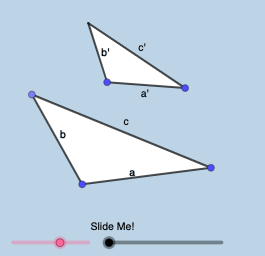
Loading the math board and drawing, please wait…
This example demonstrates the basic concepts of similar figures, focusing on similar triangles and ratios. Using GeoGebra commands such as Segment, Rotate, Ray, and Point, similar figures are constructed. Suitable for middle and high school students learning about similar triangles and ratios.
GeoGebra Commands & Parameters
Segment(A, B) → aRotate(B, (a_{2} * pi / 180), A) → B'Ray(A, B') → fPoint(f) → CSegment(A, C) → bOrthogonalLine(C, b) → rCircle(C, 1) → tIntersect(t, r, 2) → KOrthogonalLine(K, r) → i_1Point(i_1) → WRotate(E, (a_{2} * pi / 180), D) → E'Ray(D, E') → jSegment(D, E) → a'Circle(D, (a' / a * b)) → dIntersect(d, j, 1) → FSegment(D, F) → b'Line(K, b') → k_1Point(k_1) → ULine(K, a') → j_1Point(j_1) → VCircle(B, 1) → sOrthogonalLine(B, a) → qPoint(q) → MIntersect(s, q, 1) → JOrthogonalLine(J, q) → h_1Point(h_1) → PPolygon(A, B, C) → t1, c_{2}, a_1, b_{1}Polygon(D, F, E) → t2, e, d_1, f_1Min({a, a', b, b'}) → gCircle(A, (0.35 * g)) → hIntersect(h, a, 1) → GIntersect(h, b, 1) → HCircleSector(A, G, H) → kLine(A, a') → iDilate(A, If[6 < l ≤ 7, 7 - l, 0], D) → A'Vector(A, A') → uTranslate(k, u) → k'Point(i) → IAngle(I, A, B) → αCircleArc(A, G, H) → pDilate(D, If[1 < l ≤ 2, 2 - l, 0], J) → D'Vector(D, D') → vTranslate(D, v) → D'_{1}Translate(E, v) → E'_{1}Segment(D'_{1}, E'_{1}) → a''Line(J, a') → g_1Point(g_1) → LAngle(P, J, L) → βRotate(D'_{1}, If[1 < l ≤ 2, ((l - 1) * β), β], D'_{1}) → NRotate(E'_{1}, If[1 < l ≤ 2, ((-(l - 1)) * β), (-β)], D'_{1}) → OSegment(N, O) → a'''Dilate(D, If[2 < l ≤ 3, 3 - l, 0], K) → D'_{2}Vector(D, D'_{2}) → wTranslate(D, w) → D'_{3}Translate(E, w) → E'_{2}Point(j_1) → QPoint(i_1) → RAngle(W, K, U) → γRotate(D'_{3}, If[2 < l ≤ 3, ((l - 2) * γ), γ], D'_{3}) → SRotate(E'_{2}, If[2 < l ≤ 3, ((l - 2) * γ), γ], D'_{3}) → TTranslate(D, w) → D'_{4}Translate(F, w) → F'Segment(D'_{4}, F') → b''Rotate(D'_{4}, If[2 < l ≤ 3, ((-(l - 2)) * γ), (-γ)], K) → ZRotate(F', If[2 < l ≤ 3, ((-(l - 2)) * γ), (-γ)], K) → F''Segment(Z, F'') → b'''If(o, 7, 4) → c_1Angle(A, C, B) → δIntersect(t, b, 1) → A_1Rotate(A_1, If[4 < l ≤ 5, ((l - 4) * δ), δ], C) → B_1CircleSector(C, A_1, B_1) → e_1Dilate(C, If[6 < l ≤ 7, 7 - l, 0], F) → C'Vector(C, C') → u_1Translate(e_1, u_1) → p_1Line(C, b') → l_1Point(l_1) → C_1Angle(C_1, C, A) → εSegment(F, E) → m_1Segment(B, C) → cOrthogonalLine(B, c) → r_1Circle(B, 1) → s_1Intersect(s_1, r_1, 1) → D_1Dilate(E, If[3 < l ≤ 4, 4 - l, 0], D_1) → E'_{3}Vector(E, E'_{3}) → v_1Translate(F, v_1) → F'_{1}Translate(E, v_1) → E'_{4}Segment(F'_{1}, E'_{4}) → t_1Line(E, c) → f_2Point(f_2) → E_1Angle(F, E, E_1) → ζRotate(F'_{1}, If[3 < l ≤ 4, ((l - 3) * ζ), ζ], E'_{3}) → F_1Rotate(E'_{4}, If[3 < l ≤ 4, ((l - 3) * ζ), ζ], E'_{3}) → G_1Segment(F_1, G_1) → g_2Rotate(p_1, If[6 < l ≤ 7, ((-(l - 6)) * ε), (-ε)], C') → q_1Angle(B, A, C) → ηRotate(G, If[4 < l ≤ 5, ((l - 4) * η), η], A) → G'CircleSector(A, G, G') → d_2CircleArc(C, A_1, B_1) → e_2Rotate(k', If[6 < l ≤ 7, ((-(l - 6)) * α), (-α)], A') → k''Circle(B, (0.35 * g)) → h_2Intersect(h_2, c, 1) → H_1Intersect(h_2, a, 1) → I_1Angle(C, B, A) → θRotate(H_1, If[4 < l ≤ 5, ((l - 4) * θ), θ], B) → J_1CircleSector(B, H_1, J_1) → k_2Line(B, m_1) → n_1Point(n_1) → K_1Angle(K_1, B, C) → λDilate(B, If[6 < l ≤ 7, 7 - l, 0], E) → B'_{1}Vector(B, B'_{1}) → w_1Translate(k_2, w_1) → p_2Rotate(p_2, If[6 < l ≤ 7, ((-(l - 6)) * λ), (-λ)], B'_{1}) → q_2CircleArc(B, H_1, I_1) → r_2
AI Drawing Prompt Reference
Please draw a figure containing similar triangles. First, construct points A and B, then rotate point B to get B'. Next, construct a ray from A to B', and find point C on the ray. Then, construct segment AC and the perpendicular line through C, and a circle centered at C with radius 1. The intersection of the circle and the perpendicular line is K, and the perpendicular line through K intersects the perpendicular line at W. Continue constructing points D, E, F, etc., to form another triangle. Construct the similarity ratio and circular arcs to obtain two similar figures. Ensure the figure includes rotation, rays, circles, and similarity relationships.
The prompt above was compiled from the original drawing commands and is for reference only.