
SHM and UCM: isochronism
Loading the math board and drawing, please wait…
In collections
The Domain of the Time (intuitive kinematics)
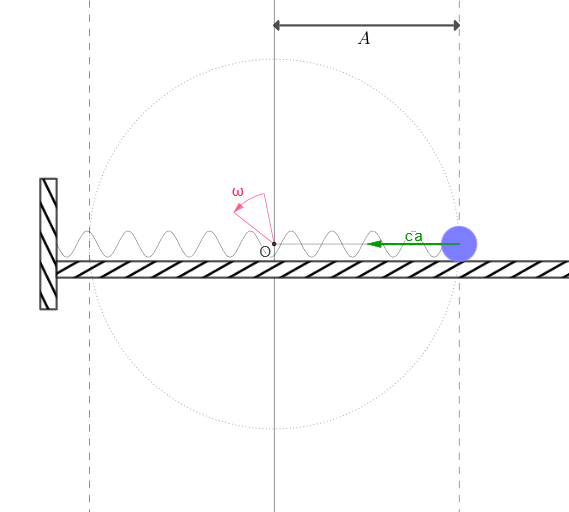
This example demonstrates the isochronism between simple harmonic motion and uniform circular motion. Key mathematical concepts include periodicity, the equivalence of circular motion and vibration. Construction involves GeoGebra commands such as Point, If, Segment, Circle, Translate, Angle, etc. Suitable for high school physics or mathematics courses to understand the connection between vibration and circular motion.
GeoGebra Commands & Parameters
Point(Segment[O, (2 * O) - P]) → QPoint(Segment[((-A), 0), (A, 0)]) → MIf(Length[reg] ≟ 1, {reg(1)}, Sequence[reg(k) - reg(k + 1), k, 1, Length[reg] - 1]) → regDifmean(regDif) → TSegment((x(Q), y(B) + 0.1), (x(O), y(B) + 0.1)) → jCircle(M, r) → cir_{1}Circle(O, A) → cirPoint(cir) → MMSegment(MM, O) → fSegment(M, MM) → gSegment(MM + c, (x(MM), y(MM + c))) → lTranslate(a, Mc) → uAngle(O + (-4, 20), O, Rotate[O + (-4, 20), ω]) → αCurveCartesian(t, (1.2 * sin(((20 * pi) * (t - (x(M) + 0.5)) / (x(P0) - (x(M) + 0.5))))), t, x(P0), x(M)) → muelle
AI Drawing Prompt Reference
Create a diagram illustrating the isochronism between simple harmonic motion and uniform circular motion. Start by drawing a circle centered at the origin. Then, draw a horizontal line segment representing the equilibrium position of the vibration. Next, draw a point on the circumference of the circle and use translation and rotation to show the relationship between the vibration and circular motion. Finally, draw a curve to represent the trajectory of the simple harmonic motion.
The prompt above was compiled from the original drawing commands and is for reference only.