
Shifting Parabola's Turning Point
Loading the math board and drawing, please wait…
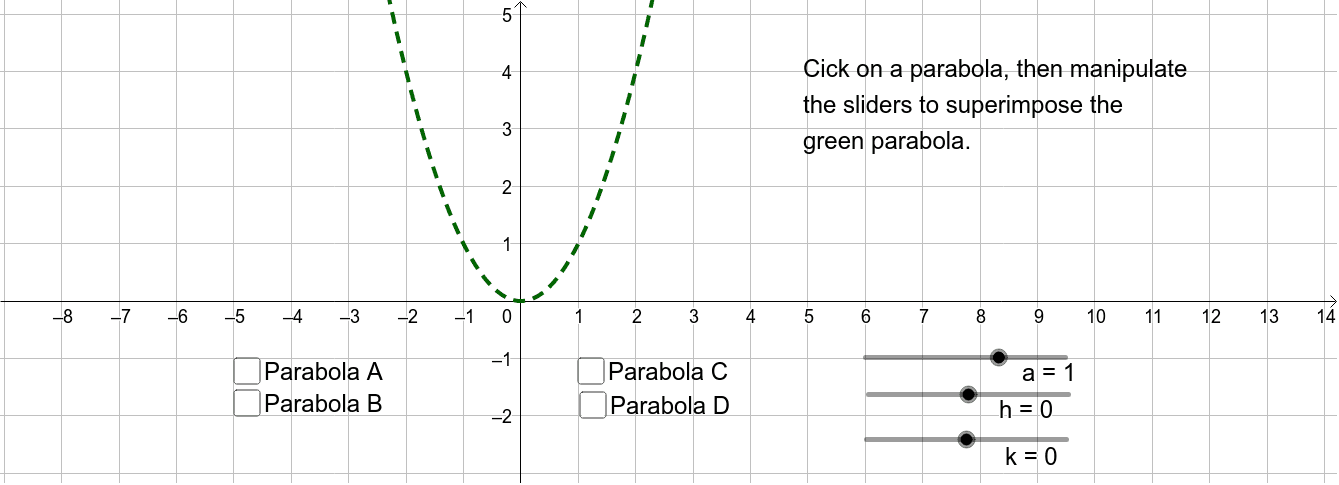
This example demonstrates how the vertex of a parabola moves as parameters change. It involves core math concepts like parabola equations, parametric equations, and coordinate geometry. Construction highlights include GeoGebra objects such as sliders a, h, k for vertex coordinates, functions f, g, and auxiliary points b, p, c, q, d, r, e, plus texts text1, text2. Suitable for high school mathematics teaching to understand standard parabola equations and their translations.
GeoGebra Commands & Parameters
Numeric a(1.0)Numeric h(0.0)Numeric k(0.0)f(x) = (a * (x - h)^(2)) + kg(x) = (0.5 * (x - 2)^(2)) + 3Boolean b(false)p(x) = (-(x - 1)^(2)) + 4Boolean c(false)q(x) = (-2 * (x - 4)^(2)) + 5Boolean d(false)r(x) = (x + 4)^(2) - 3Boolean e(false)
AI Drawing Prompt Reference
Draw a parabola y = a(x - h)² + k with its vertex at (h, k), where a, h, and k are adjustable sliders. Start with the standard parabola y = x², then observe how the vertex moves by adjusting a, h, and k. Next, draw several specific parabolas, such as one with vertex at (1, 4) given by y = -(x - 1)² + 4, another with vertex at (4, 5) given by y = -2(x - 4)² + 5, and one with vertex at (-4, -3) given by y = (x + 4)² - 3.
The prompt above was compiled from the original drawing commands and is for reference only.